
When can you get LASIK? Once you're 18 or older and your prescription has stayed the same for about a year. For a Seoul trip, plan about 3–5 days, with the check-up on the morning after surgery.
Is 18 old enough for LASIK?
Is 40 too late?
A high prescription is a reason to wait for better lasers
Can you get LASIK while pregnant or breastfeeding?
Contacts can stay in until the flight
Which days of a Seoul trip work for surgery?
What decides the cost of LASIK?
Risks and side effects that timing doesn't remove
What to have on your phone before you message
Are you asking when can you get lasik because you're worried you're too young, too old, or should wait for a better laser?
Read on before you book flights or pick dates, because a few common timing beliefs are wrong.
After this you will know the age and prescription rules, what decides the cost, what review threads claim versus what is medically true, and how the methods fit a short trip to Seoul.
Hello, I'm Dr. Baek Dong-won, Representative Director of EYEONCE.
At EYEONCE in Seoul, in-house interpreters speak English, Chinese, Mongolian and Thai. For suitable candidates, exam and surgery can often happen on the same day, with a check-up the next day before you fly. Lifetime aftercare covers a detailed re-examination if something seems wrong once you're home.
I wrote this because many people treat age or a new laser model as the deciding factor, when the real gate is how steady your eyes are.
The short answer: you can get LASIK once you're an adult and your prescription has held steady for about a year.
Eighteen is the minimum, and on its own it is not a green light. The U.S. Food and Drug Administration lists who is probably not a good LASIK candidate: anyone under 18, and anyone whose prescription changed in the past year.
The FDA also names people in their early 20s or younger among those more likely to have an unstable prescription.
The mechanism is plain. The laser reshapes the cornea to match the prescription you have today. If the eye is still lengthening, as nearsighted eyes often do into the early twenties, the blur returns on top of a cornea that has already been treated. A long-term Korean study of myopic regression after LASIK and LASEK for moderate myopia looked at which preoperative factors went along with the number drifting back over the years.
What decides it in practice is a comparison. Two prescriptions a year apart that match, plus a regular map, answer the age question better than any number of candles. If the prescription is still moving, the right date is after it stops.
There is no upper age written into the rules, but in your 40s the question changes. The American Academy of Ophthalmology explains that presbyopia, the gradual loss of close-up focus, usually starts to show after 40. LASIK aimed at distance vision does nothing to stop it.
So a 44-year-old who corrects distance with LASIK may still reach for reading glasses within a few years. That trade is fine for some people and a disappointment for others, and it's worth naming before surgery.
EYEONCE's own guidance is that between 45 and 55 several options may apply, that cataracts usually develop from the 50s–60s onward, and that a premium IOL can correct cataract and presbyopia together. For someone in their early 50s with the first signs of lens clouding, asking about a lens-based approach can be the more useful question than asking about LASIK.
Waiting rarely changes the answer for a high prescription, because the limit is usually your cornea and not the machine. Every laser method reshapes corneal tissue, and a thin cornea stays thin no matter which year you book.
What can change is the method. EYEONCE runs two laser platforms: the WaveLight EX500 excimer laser for all-laser LASIK and LASEK, and the Ziemer FEMTO Z8 femtosecond laser for SMILE LASIK and for corneal flap creation in LASIK.
LASEK treats the surface without a flap; the clinic notes it can be preferable for thinner corneas or high-impact lifestyles, and the American Academy of Ophthalmology's EyeWiki entry on LASEK describes how the surface layer is lifted and replaced. If you're weighing that route, our guide to who LASEK is for goes further.
When laser isn't a fit, ICL (EVO Aqua ICL with CentraFLOW) is the other path. The clinic describes it as an option for high myopia, thin corneas, dry eyes, or prescriptions outside the safe range for laser, and the lens can be removed or exchanged later if needs change. How high myopia and astigmatism are weighed together is covered in this assessment walkthrough.
A "no" at home usually rests on corneal thickness and shape, and those numbers rarely improve in a year. I'd rather tell someone that a laser doesn't suit their cornea and talk about a lens option than move the date and hope. Patience makes sense when the prescription is still changing. When the cornea itself is the limit, waiting only delays the same conversation.
Not during pregnancy or while breastfeeding. The FDA lists both among the situations that can make a prescription fluctuate, along with hormone changes from diseases such as diabetes and some medications. A measurement taken in those months may not be the number your eye settles on later.
The same FDA page flags diseases and medications that can affect wound healing. If either applies, mention it in your first message, alongside your prescription photos. The timing then becomes the date your prescription has settled again, and the exam is what confirms that.
Contact lenses press the cornea into a slightly different shape, so the measurements need a break first. EYEONCE's stated break times before the exam:
Count backward from the exam, not from the flight. An RGP wearer with an exam on a Monday needs to stop lenses three weeks before that Monday, which often means wearing glasses at work for a while. Bring those glasses and any prescription records, skip eye makeup on exam day, and arrange a companion or transport for surgery day.
Plan about 3–5 days, and if you want the check-up on the very next morning, put surgery on a Monday, Thursday or Friday. EYEONCE is open Mon, Tue, Thu and Fri 09:00–18:00 and Sat 09:00–16:00 (lunch 13:00–14:00), closed Wednesdays and Sundays, and appointments are required.
| Surgery day | Next morning | Next-day check possible? |
|---|---|---|
| Monday | Tuesday | Yes |
| Tuesday | Wednesday (closed) | No, plan an extra day |
| Thursday | Friday | Yes |
| Saturday | Sunday (closed) | No, plan an extra day |
The clinic is on floors 5–6 of Duo Sinnonhyeon, a 3-minute walk from Exit 3 of Sinnonhyeon Station (Line 9 and Sinbundang Line), and roughly 60–75 minutes by taxi from Incheon International Airport. Landing the evening before the exam leaves room for a delayed flight. The surgery itself takes about 10–15 minutes for both eyes, and most patients notice clearer vision within hours, with the next-day check before the flight home.
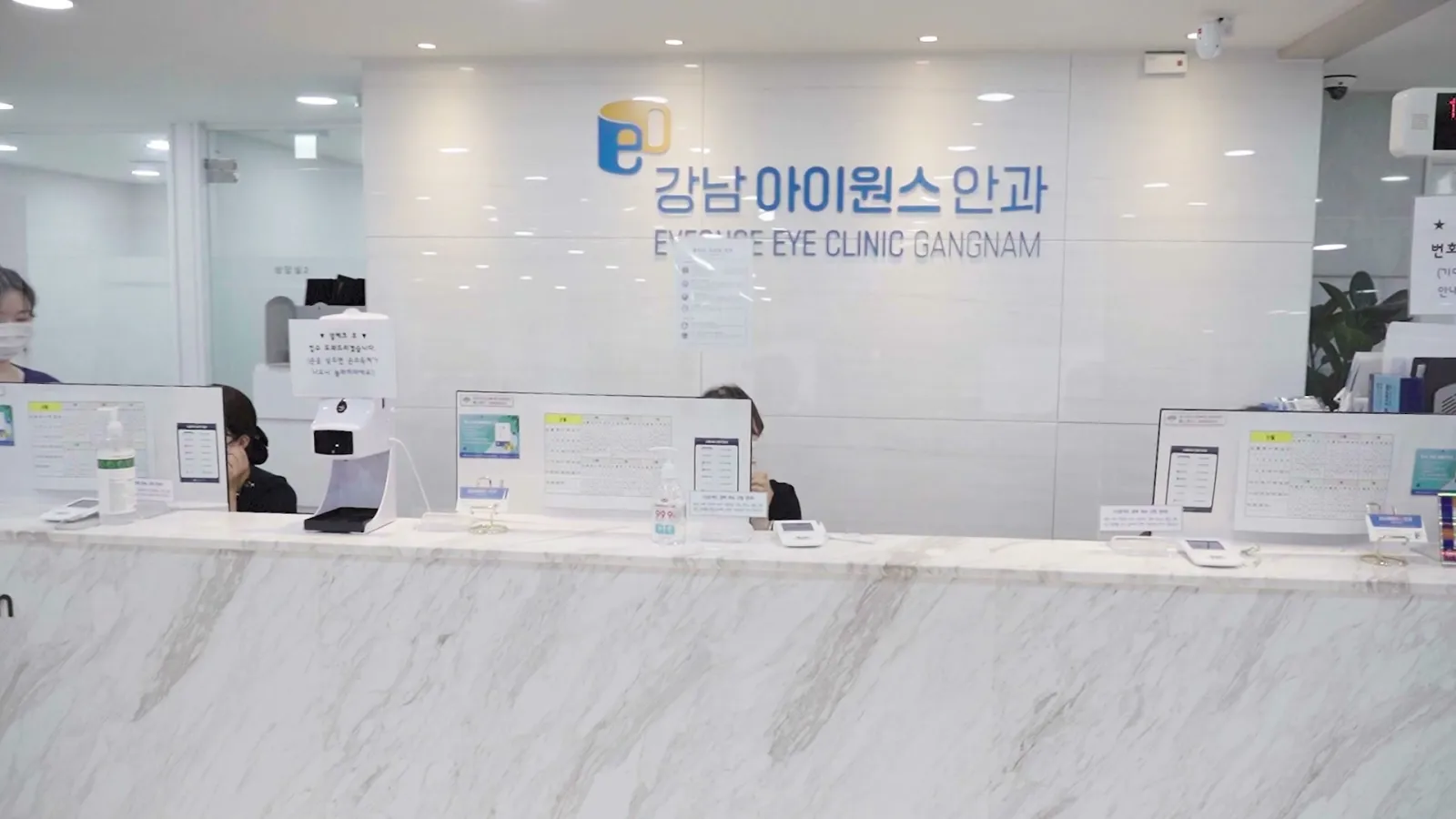
If your leave dates are fixed, send them on WhatsApp with one line about your lenses (soft, hard or ortho-k) and when you last wore them. Those two details set your last lens day and where the exam, surgery and next-day check land inside your window, and the schedule comes back built around them.
Say you're 27, live abroad, and have one week of leave. Your last two prescriptions are almost identical, so stability looks good. I would start there, because it matters more than your age or whether a newer laser exists. Next I would count back from your travel dates: soft contact lenses come out at least 5–7 days before the exam, so that date is your first fixed point. If the exam shows your eyes are suitable, surgery can often be done the same day. The next-day check-up then sits before your flight, and the rest of the week stays free for the gradual healing that follows.
The cost depends on the method you and the doctor choose: LASIK, SMILE LASIK, SMILE PRO or LASEK. It also depends on your prescription, your corneal thickness and your overall eye health, because these decide which methods suit you at all. The number of days you stay in Korea matters too, since laser vision correction usually takes about 3–5 days, including the next-day check-up. Anaesthesia is topical numbing drops, so it is not a big separate factor. Follow-up is part of the picture as well, because lifetime aftercare covers a detailed re-examination if you need one later. To get the figure for your own case, message us on WhatsApp with a photo of your latest prescription.
Good timing lowers some risks; it does not remove them. The FDA's page on what to expect during and after LASIK describes discomfort and hazy vision in the first days and the instruction not to rub the eye.
Dry eye, glare and halos at night are known side effects, and for most people they ease as the cornea heals, though not for everyone.
EYEONCE's guidance is that temporary haziness and some fluctuation over the first 1–3 months are normal while the cornea heals, with screens kept down where possible and the prescribed eye drops and artificial tears used as directed. Regression, the slow return of some nearsightedness, is the longer-term risk the Korean study above examined. Results differ from person to person, and candidacy itself is decided at the in-person exam.
If you feel a foreign-body sensation or pain after you're home, the clinic's instruction is to see a local ophthalmologist first and then contact EYEONCE. Under lifetime aftercare, a detailed re-examination assesses the eye and, where appropriate, a re-treatment is arranged; the specific conditions are confirmed at consultation.
A symptom on day four feels bigger when you're a long flight away from Seoul. Before you leave home, find out which local ophthalmologist you could see at short notice, and keep the WhatsApp thread you used to plan the trip. That way a worry at 2 a.m. has two places to go.

Four things make the first message useful: photos of your prescriptions from the last year or two, your lens type and last wear day, your travel window, and any medication, health condition or pregnancy plan.
If you want background before writing, what to check first for LASIK in Korea and how SMILE LASIK recovery fits daily life cover the procedure side, and the EYEONCE home page lists every procedure.
Send two things on WhatsApp: a photo of your last two prescriptions, and the travel window you're considering. When you come in, I examine your eyes and recommend what fits them.
Results and suitability vary by individual. Your procedure recommendation is confirmed only through an in-person diagnostic exam.

Representative Director · Former Clinical Instructor, Dept. of Ophthalmology, Samsung Seoul Hospital · Member, Korean Society of Cataract and Refractive Surgery · Member, American Society of Cataract and Refractive Surgery
International patients share what actually happened — from their first fears to waking up the next morning without glasses.
Our patients share their stories on Google — verified, public and unfiltered. Open the map to read every review straight from the source.
Tell us your prescription and travel dates. Our English-speaking team will design your personalized plan — free of charge, no pressure.
An English-speaking eye clinic in the heart of Gangnam, Seoul — moments from Sinnonhyeon Station and easily reached from Incheon International Airport.
5–6F, Duo Sinnonhyeon, 368 Sapyeong-daero, Seocho-gu, Seoul, South Korea
+82-10-6308-0984 — English, Chinese, Mongolian & Thai
Mon, Tue, Thu, Fri 09:00–18:00 · Sat 09:00–16:00 · Lunch break 13:00–14:00 · Closed Wed & Sun
By appointment only · Registration may close early depending on the day’s schedule.
Sinnonhyeon Station (Line 9 / Sinbundang Line) — 3 min walk. Gangnam Station (Line 2) nearby.