
LASIK is a long-established procedure for adults with a stable prescription and a healthy, thick-enough cornea. Unstable vision, keratoconus, thin corneas, pregnancy and some healing conditions change the answer.
What decides whether LASIK is safe for one particular eye
Which eyes should not have LASIK at all?
Eyes where the answer is not yet
Is LASIK safe with thin corneas or a high prescription?
Side effects that remain even in a good candidate
What happens if something goes wrong after you fly home?
How do you plan the trip so the check-up isn't squeezed?
Is LASIK safe? LASIK is a long-established procedure for an adult with a stable prescription, a healthy cornea that is thick enough for the planned correction and no condition that slows healing, though it is still surgery and its side effects are real. If you're flying to Korea for it, the worry usually sits one step further out: what happens if something feels wrong after you're back home, far from the surgeon who operated. At EYEONCE in Gangnam, one doctor carries you through diagnosis, surgery and follow-up, and the clinic's Lifetime Aftercare means re-examination whenever you need it, with re-treatment support where appropriate (the detailed conditions are confirmed at consultation).
Most people who type is lasik safe into a search bar are really asking about their own eyes, and many have already heard no, or borderline, from a surgeon at home. The useful answer comes as three lists: eyes that shouldn't have LASIK, eyes that should wait, and eyes where surgery is reasonable but a different procedure fits better.
If you have a recent eye exam report, or just your glasses prescription, send a photo on WhatsApp together with the dates you're considering. The clinic's WhatsApp consultation runs in English, Chinese, Mongolian and Thai.

How much healthy cornea is left after the laser finishes. In LASIK, a femtosecond laser creates a thin flap, an excimer laser reshapes the tissue underneath, and the flap is laid back without stitches. The higher the prescription, the more tissue is removed, and what remains has to stay strong for decades.
At EYEONCE the flap is made on the Ziemer FEMTO Z8 and the reshaping is done on the WaveLight EX500 excimer laser, which tracks eye movement during treatment. Neither machine decides whether you're a candidate.
Thickness alone can mislead. A pattern that should make any surgeon pause is a lower cornea that is slightly steeper than the upper half, or a cornea that is thinnest away from its center. A thick cornea with that kind of irregular map is a bigger concern than a thinner cornea with a smooth, symmetric one, because the irregular map can be an early sign of keratoconus.
Eyes with keratoconus or a map that suggests early corneal weakening, corneas too thin for the planned correction, and eyes or bodies that heal poorly. In these cases, cutting a flap and removing tissue adds risk that the vision gain doesn't justify.
The U.S. Food and Drug Administration's page When is LASIK not for me? lists conditions that make someone a poor candidate. In plain terms:
A no to LASIK is not always a no to vision correction. Some of these eyes can be considered for a surface procedure or a lens implant instead, which comes up two sections below.
In short, this is the list people find most frustrating, because nothing is wrong with the eye. The timing is wrong.
Not yet is the easiest answer to hear once you know it comes with a date attached.
Often the safer route for these eyes is a different procedure. The question becomes which kind of vision correction suits your cornea and your life. The table below shows the usual reasoning.
| What the exam finds | Why LASIK is a concern | What can be considered |
|---|---|---|
| Thinner cornea | The flap uses up depth | LASEK (surface, no flap) |
| Contact sports or impact risk at work | A flap can shift after a blow to the eye | LASEK |
| Very high myopia or astigmatism | A lot of tissue would be removed | EVO Aqua ICL |
| Very dry eyes or large pupils at night | Laser can worsen dryness; night glare is more noticeable | EVO Aqua ICL |
LASEK reshapes the surface after loosening the outer layer instead of cutting a flap. The American Academy of Ophthalmology's EyeWiki entry on LASEK describes it as a surface ablation option, with a slower and less comfortable first week than LASIK in exchange for no flap. Our guide to who LASEK is actually for covers that trade-off in detail.
The EVO Aqua ICL with CentraFLOW is a lens placed behind the iris and in front of your natural lens through a roughly 3 mm incision. No corneal tissue is removed, and the lens can be taken out if needed. It's surgery inside the eye, with its own risks, so it is a different decision, not a lighter one. If high myopia and astigmatism are your situation, how we assess the two together goes further.
When a surgeon at home has said no, that answer is data, and often good data. If the corneal map here shows the same thing, the answer here should be the same. What can differ is the next question: whether LASEK or a lens implant is reasonable for an eye that shouldn't have a flap.
Passing every screening test lowers the risk without removing it. The FDA's guide What should I expect during and after surgery? describes burning, itching or a foreign-body feeling in the first hours, blurry vision early on, and a first follow-up visit within a day or two.
What people notice most in the following weeks and months:
The clinic's recovery rules exist because of that list: no eye rubbing, protective shields while sleeping in the early days, no swimming, sauna or steam rooms for about a month, no eye makeup for two weeks, and every prescribed drop used as instructed. Whether your own eyes belong on the yes list is decided at the in-person exam, not by any article.
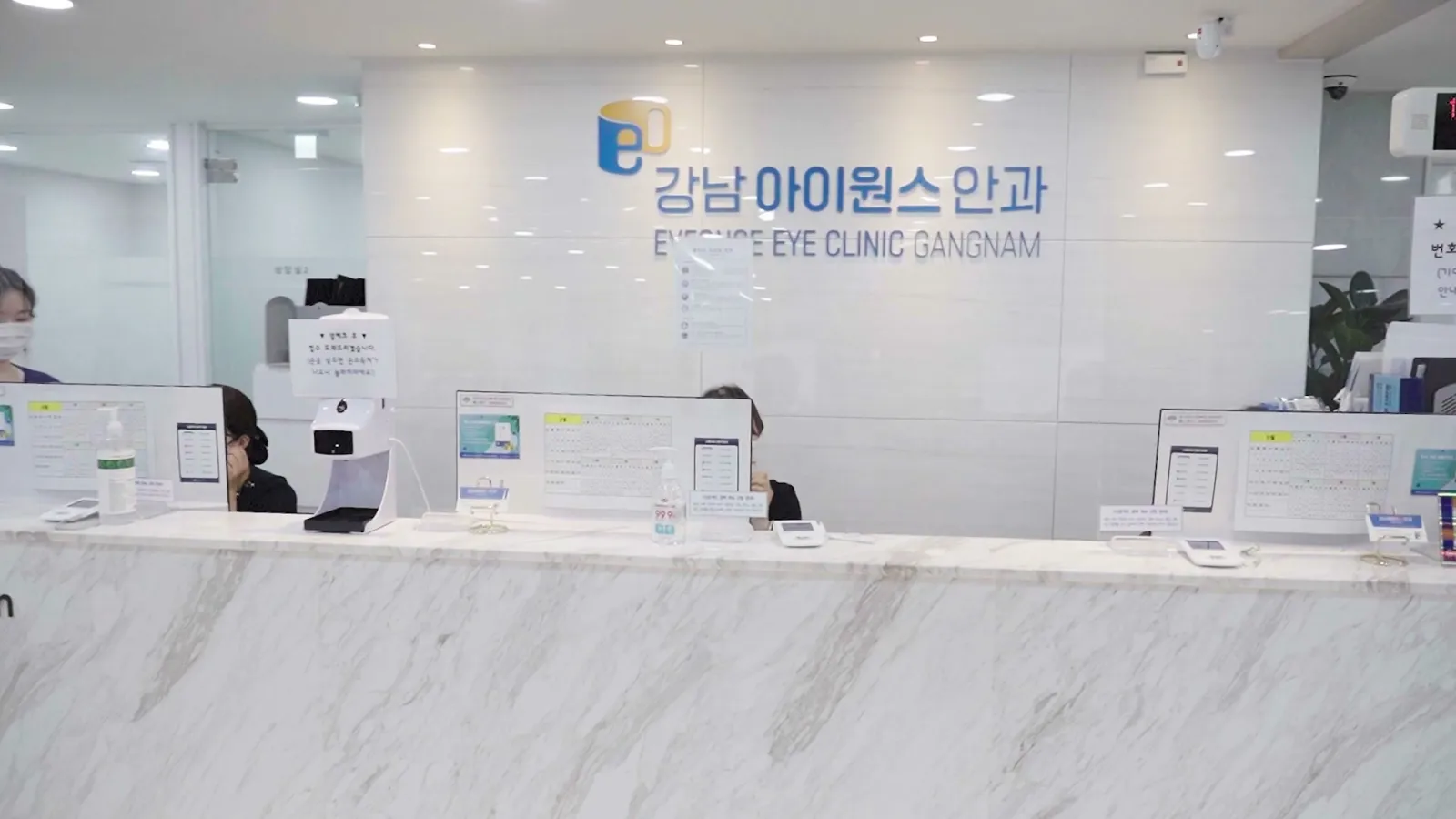
You have two routes, and the clinic's guidance names both. If you feel pain or a foreign-body sensation, visit the clinic right away if you're still in Seoul. If you're already home, see a local ophthalmologist first, then contact EYEONCE on WhatsApp. Under Lifetime Aftercare, the clinic reviews a detailed re-examination and, where appropriate, arranges re-treatment.
The U.S. Centers for Disease Control and Prevention's medical tourism guidance advises carrying copies of your records home and planning follow-up care with a doctor where you live. For eye surgery, that means your pre-op measurements, the operative details and your drop schedule, in a form your local ophthalmologist can read. Booking a check-up at home before you leave makes the first week back less lonely.
The next-day check-up in Seoul matters most here. It's when the flap position and early healing are looked at by the person who operated, before you board a plane.
If follow-up from home is your main hesitation, send your travel dates and your home city on WhatsApp.
Plan 3 to 5 days in Seoul for laser vision correction and 5 to 7 for ICL. Exam and surgery can often happen on the same day, followed by the next-day check-up before you fly.
The clinic calendar matters more than people expect. EYEONCE is open Monday, Tuesday, Thursday and Friday from 09:00 to 18:00 and Saturday from 09:00 to 16:00, with lunch from 13:00 to 14:00, and is closed on Wednesdays and Sundays. Surgery on a Monday, Thursday or Friday leaves an open day after it for the check-up; Tuesday or Saturday surgery runs into a closed day. Appointments are required, and registration can close early on busy days.
The clinic is on the 5th and 6th floors of Duo Sinnonhyeon, 368 Sapyeong-daero, Seocho-gu, and its site lists routes from Incheon Airport by taxi, AREX plus subway, or limousine bus. For what the first days after surgery feel like, our piece on returning to daily life after SMILE LASIK walks through it, and what to check before LASIK in Korea covers the paperwork side.
If you've already been told no or borderline at home, that report is the most useful thing you can send. Photograph the corneal thickness and topography pages, add your current prescription and the one question you most want answered, and send them on WhatsApp.
Results and suitability vary by individual. Your procedure recommendation is confirmed only through an in-person diagnostic exam.

Representative Director · Former Clinical Instructor, Dept. of Ophthalmology, Samsung Seoul Hospital · Member, Korean Society of Cataract and Refractive Surgery · Member, American Society of Cataract and Refractive Surgery
International patients share what actually happened — from their first fears to waking up the next morning without glasses.
Our patients share their stories on Google — verified, public and unfiltered. Open the map to read every review straight from the source.
Tell us your prescription and travel dates. Our English-speaking team will design your personalized plan — free of charge, no pressure.
An English-speaking eye clinic in the heart of Gangnam, Seoul — moments from Sinnonhyeon Station and easily reached from Incheon International Airport.
5–6F, Duo Sinnonhyeon, 368 Sapyeong-daero, Seocho-gu, Seoul, South Korea
+82-10-6308-0984 — English, Chinese, Mongolian & Thai
Mon, Tue, Thu, Fri 09:00–18:00 · Sat 09:00–16:00 · Lunch break 13:00–14:00 · Closed Wed & Sun
By appointment only · Registration may close early depending on the day’s schedule.
Sinnonhyeon Station (Line 9 / Sinbundang Line) — 3 min walk. Gangnam Station (Line 2) nearby.