
Presbyopia lens surgery can fit inside a school holiday if the break holds an exam, two operations some days apart, a check after each, and a few quiet days before term starts.
If you teach and your reading glasses spend the day swinging between your nose and a cord around your neck, presbyopia lens surgery can fit inside a school holiday. The holiday has to hold two operations rather than one, though, plus a few days for your eyes to settle before you face a class again. Treat this as a Seoul presbyopia school-holiday plan built around one worry: starting term still holding the attendance list at arm's length.
I examine your eyes, I operate, and I follow your recovery myself. With lens surgery that continuity matters, because the lens is chosen from measurements of your eye and from how you use your eyes across a teaching day, and the person checking the result should be the one who made those choices.
If you're not sure your break is long enough, send your term dates and your current glasses prescription on WhatsApp, and ask the question that decides it: can both eyes be done and checked inside those dates? I review it personally before you book a flight.
Long enough for an exam, two separate operations, a check after each, and a margin before term starts. That usually rules out a long weekend. The exact number of days depends on your measurements and on how far apart the two eyes are done, so get that number before you book anything.
A short mid-term break is often the tightest fit. The longer summer or winter holiday leaves room for the second eye and for a few quiet days at home before the first lesson. If your holiday is fixed and short, it's better to know early and plan for the next one than to squeeze the second eye into the last two days.
Two fixed points on the calendar are worth writing down. The clinic is closed on Wednesdays and Sundays, Saturday hours end at 16:00, and there's a lunch break from 13:00 to 14:00. Appointments are required. If a surgery date falls on a Tuesday, ask how the next-day check is arranged, since the following day is a closed day.
Presbyopia isn't a problem with the front of your eye. The American Academy of Ophthalmology describes it as the natural lens inside the eye gradually stiffening with age, so it can no longer shift focus for close work; most people start noticing it in their 40s. That's why laser procedures such as LASEK, and who it actually suits, reshape the cornea for distance but don't treat the cause.
If you're under 40 and simply nearsighted, the guide to how prescription numbers decide between laser and lens procedures fits your situation better than this one.
Lens surgery for presbyopia removes the natural lens and replaces it with an intraocular lens that has its focusing ranges built in. It uses the same technique as cataract surgery; when the lens isn't cloudy yet, it's often called refractive lens exchange. One consequence people don't expect: once the natural lens is gone, it can't later turn into a cataract.
Why not both eyes on the same day? Many surgeons operate on one eye, check it the next day, and do the second eye some days later. That gap lets the first eye show how it healed, including eye pressure, inflammation and the actual focusing result, before the second eye is committed. For anyone on a school calendar, this gap is the single biggest factor in trip length.
Before you travel, if you wear contact lenses, ask how many days to leave them out before the exam. Lenses change the cornea's shape for a while, and the lens calculation needs its true shape.
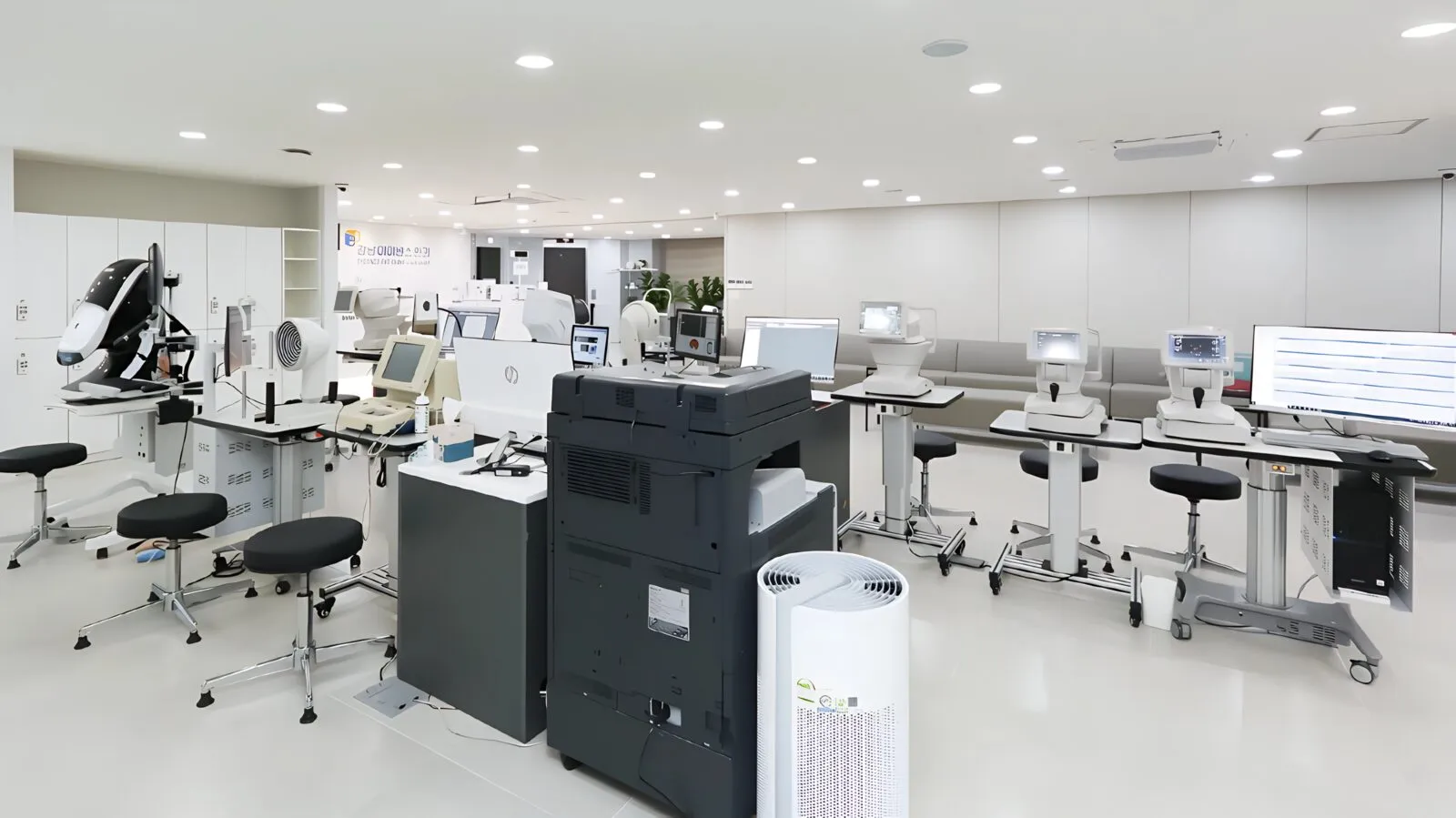
Exam day is about numbers. The diagnostics room runs Topcon imaging stations for corneal topography, pachymetry (corneal thickness), OCT scanning, and automated refraction and keratometry. Every safe outcome starts with measurement, not guesswork, and with lens surgery those numbers set the power of a lens you'll live with for decades.
On surgery day, your eye is numbed with drops, and most people notice pressure more than pain. Vision is often hazy for the rest of the day, so bring someone with you and plan nothing.
Ask at your consultation when your first check will fall, and plan your stay around it. Distance often clears early.
Once both eyes have their new lenses, they work together, and reading usually starts to feel more even.
If you're flying in, the clinic's site lists the routes from Incheon Airport by taxi, AREX train plus subway, or limousine bus to the clinic in Seocho-gu. Uncomplicated lens surgery generally doesn't stop you from flying home, but confirm it at your last check.
At home, before term, you'll be on a schedule of eye drops for some weeks. Rings or halos around headlights and streetlights are common at first with multifocal lenses, and near focus tends to improve as your brain learns to use the new optics. Lens recovery runs on a different clock from laser recovery; if you've read about lasers, the SMILE LASIK recovery timeline shows how the cornea's healing differs.
In your first week back, the whiteboard and the laptop are usually the easy part. Small handwriting under classroom lighting can take longer, so a cheap pair of readers in the desk drawer is a sensible backup for the first weeks. That's the whole shape of a Seoul presbyopia school holiday: a surgery date, a check afterwards, and enough slack that the first lesson isn't also your first test.
Teaching uses three distances in one hour: the board across the room, the laptop at arm's length, and exercise books in your hand. Lenses split those differently. The clinic's lens range covers monofocal, trifocal and extended-depth-of-focus (EDOF) lenses, with toric versions for astigmatism; names you may see include Clareon PanOptix, Vivity and FineVision.
| Lens type | What it covers | The trade-off |
|---|---|---|
| Trifocal (e.g. PanOptix, FineVision) | Board, screen and close reading | Halos around lights at night are more common, and adapting takes weeks |
| EDOF (e.g. Vivity) | Board and screen, some near | Small print or red-pen marking may still need readers |
| Monofocal | One distance, usually far | Reading glasses for close work, unless the eyes are set for different distances |
Toric versions exist for each when astigmatism needs correcting, and the lens is matched to how you live, not only to your prescription. If you're also very nearsighted or have marked astigmatism, the measurements get more involved; the piece on how we assess high myopia and astigmatism together covers that side.
The question I'd ask you first isn't your age. It's what you do after 6 pm. If you mark essays at the kitchen table, a trifocal or EDOF lens earns its trade-offs. If you drive home through dark winter evenings and halos would bother you more than reaching for readers, I'd lean the other way. Between 45 and 55 several options can apply, so this is a conversation, not a menu.
The common effects are temporary: dryness, glare and halos at night, and near vision that comes and goes in the first weeks. Less often, inflammation or a rise in eye pressure needs extra drops, or the final focus lands slightly off and glasses or a further procedure are needed for some tasks.
Months or years later, the thin membrane behind the new lens can turn cloudy. A short laser treatment usually clears it. Rare but serious problems include infection inside the eye and retinal detachment; the American Academy of Ophthalmology's EyeNet debate on refractive lens exchange points out that retinal detachment is a larger concern in highly nearsighted eyes.
Some people are better off waiting or not doing it: those whose early presbyopia is still handled well by readers, those with retinal or other eye disease that limits what a new lens can give, and those who can't accept any halos at night. Whether your eyes are suitable is decided at the in-person exam, and recovery varies from person to person.
If something feels wrong after you're home, such as pain, worsening vision, new flashes or a shower of floaters, see a local ophthalmologist that day, then contact us. Lifetime Aftercare means you can come back for a re-check at any time, with re-surgery or re-treatment supported if it's needed; the detailed terms are confirmed at consultation.
Before you settle on dates, send a list of any eye conditions you've been told about on WhatsApp, such as glaucoma, a retinal tear or dry eye, and ask whether any of them changes the lens choice.
You won't be handed off to a surgeon you've never met. The person who measures your eyes is the person who operates and the one who checks you before you fly. We only go ahead if your pre-op exam confirms you're a safe candidate, and if that exam points away from lens surgery, I'll explain the reasoning.
I'm a member of the Korean Society of Cataract and Refractive Surgery and the American Society of Cataract and Refractive Surgery, and a co-author of the Textbook of Dry Eye (2019), which matters here because dryness is one of the most common complaints in the first weeks. WhatsApp consultation is available in English, Chinese, Mongolian and Thai.
When you message on WhatsApp, tell me the one thing you most need to see in class, whether that's the board, a laptop or a stack of exercise books, because that single answer shapes the lens conversation more than your age does.
Results and suitability vary by individual. Your procedure recommendation is confirmed only through an in-person diagnostic exam.

Representative Director · Former Clinical Instructor, Dept. of Ophthalmology, Samsung Seoul Hospital · Member, Korean Society of Cataract and Refractive Surgery · Member, American Society of Cataract and Refractive Surgery
International patients share what actually happened — from their first fears to waking up the next morning without glasses.
Our patients share their stories on Google — verified, public and unfiltered. Open the map to read every review straight from the source.
Tell us your prescription and travel dates. Our English-speaking team will design your personalized plan — free of charge, no pressure.
An English-speaking eye clinic in the heart of Gangnam, Seoul — moments from Sinnonhyeon Station and easily reached from Incheon International Airport.
5–6F, Duo Sinnonhyeon, 368 Sapyeong-daero, Seocho-gu, Seoul, South Korea
+82-10-6308-0984 — English, Chinese, Mongolian & Thai
Mon, Tue, Thu, Fri 09:00–18:00 · Sat 09:00–16:00 · Lunch break 13:00–14:00 · Closed Wed & Sun
By appointment only · Registration may close early depending on the day’s schedule.
Sinnonhyeon Station (Line 9 / Sinbundang Line) — 3 min walk. Gangnam Station (Line 2) nearby.