
Most Seoul presbyopia corrections are lens surgery: the stiffened natural lens is replaced with an implant that focuses at more than one distance. The real choice is how much night halo you'll accept for reading without glasses.
Most Seoul presbyopia corrections you'll come across are lens surgery: the natural lens inside your eye, which has slowly stiffened, is removed and replaced with an artificial lens designed to focus at more than one distance. It's the same operation as cataract surgery, done before a cataract has formed. The worry that usually sits under this search is a blunt one: will I trade my reading glasses for halos around every headlight when I drive at night?
One thing stays the same whichever lens we end up discussing. At EYEONCE, the surgeon who evaluates you is the surgeon who operates on you and follows your recovery. I lead your consultation, I perform the surgery, and I'm the one you come back to if the halos bother you.
If night driving is the part that worries you, send a photo of your current glasses prescription on WhatsApp with your age and how many evenings a week you drive, and ask one question: which lens type keeps my night vision closest to what it is now? I review it personally before you book a flight.
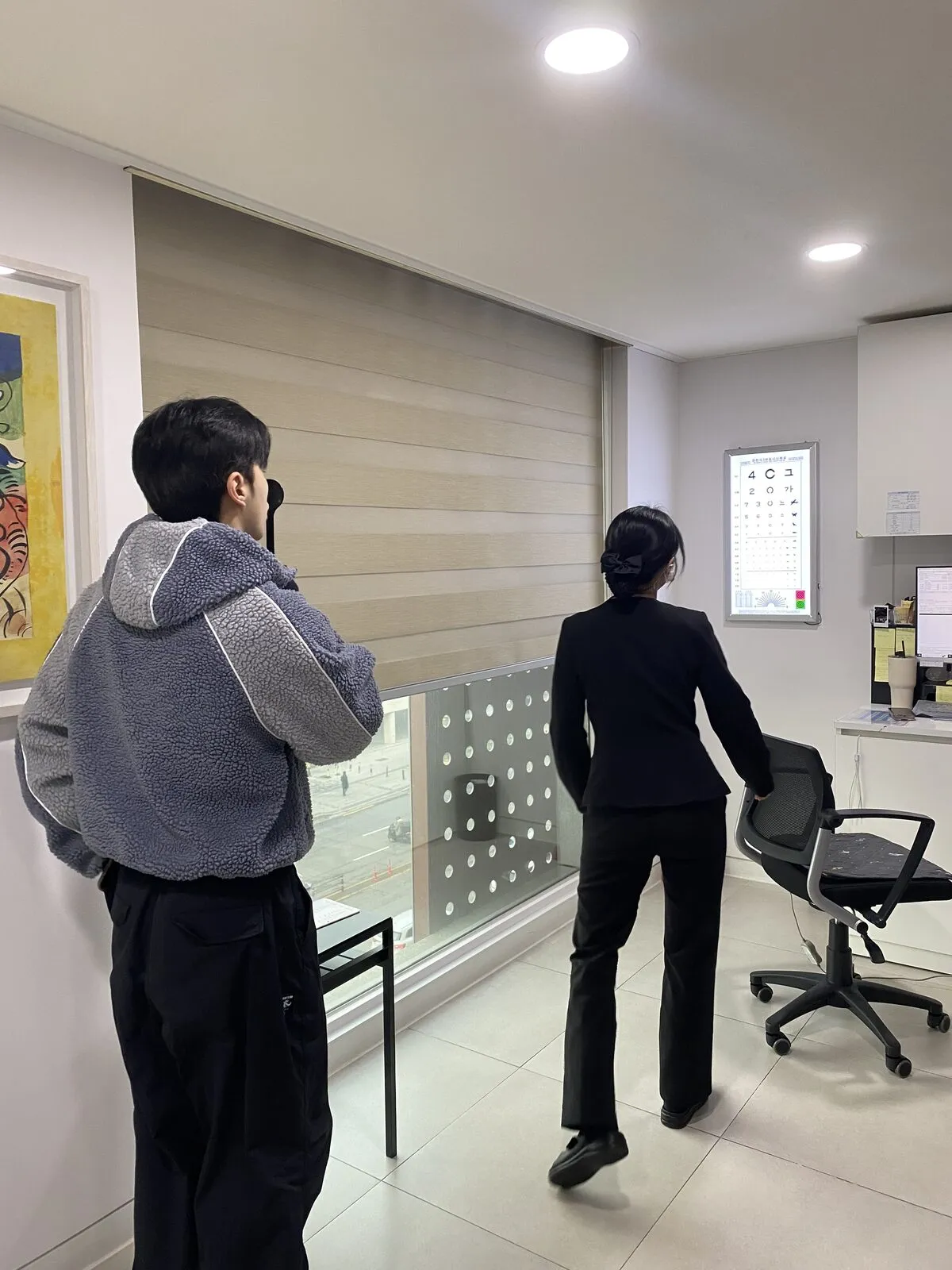
Presbyopia isn't a corneal problem. The American Academy of Ophthalmology describes it as the lens inside the eye losing its flexibility with age, usually becoming noticeable somewhere after 40. A younger lens changes shape to pull near objects into focus. By the mid-40s it barely moves, so the phone drifts to arm's length.
That's why a corneal laser on its own can't give back the focusing range. LASIK and LASEK reshape the clear window at the front of the eye; they move where your focus sits, not how far it reaches. Lens-based correction swaps the stiff lens for an intraocular lens (IOL) whose optics are built to cover more than one distance. The lens options I work with span monofocal, trifocal and extended-depth-of-focus (EDOF) designs, with toric versions for astigmatism.
If you're still in your 30s and your problem is distance blur, presbyopia correction isn't your question yet. That's a laser conversation, and how myopia and astigmatism numbers decide a laser procedure covers it.
Most of the confusion in this field is vocabulary. Each clinic page and forum thread uses a slightly different name for the same handful of ideas, and the trade-offs are easier to weigh once the labels line up.
| Term | What it does | What you give up |
|---|---|---|
| Monofocal | One sharp focus, usually set for distance | Reading glasses for near work; the fewest rings around lights in most eyes |
| Monovision | One eye set for distance, the other for near | Some depth perception; not every brain accepts the split |
| Trifocal (e.g. Clareon PanOptix) | Divides light between near, middle and far focus points | Halos and glare at night are more likely; slight loss of contrast |
| EDOF (e.g. Vivity) | Stretches one focus from distance to arm's length | Small print often still needs weak readers |
| Toric | Any of the above with astigmatism correction built in | Has to sit at the right angle; occasionally needs repositioning |
Three more terms come up once you start reading surgical pages. Refractive lens exchange (RLE) is the name for this surgery when it's done to change focus rather than to remove a cataract. Neuroadaptation is the weeks to months during which your brain learns to tune out the rings a multifocal lens creates. Posterior capsule opacification is a haze that can form months or years later on the thin membrane holding the new lens; a short laser treatment usually clears it.
Some halo around headlights is common in the first weeks with any new lens. With trifocal optics it's more likely, and it can last longer. The AAO's guide to IOL implants notes that multifocal lenses can cause glare or halos, and that some people adapt to them better than others.
The reason is physical. A trifocal splits incoming light so that near, middle and far each get a share. At night your pupil opens wide, and the out-of-focus share shows up as rings around point lights: headlights, streetlamps, the brake lights in front of you. An EDOF lens spreads focus along a continuous range instead of separate points, which is why it tends to produce less ringing, at the cost of reading the smallest print.
How much of that ring you notice is shaped by your pupil size in dim light, how regular your cornea is, and the health of your retina. Every safe outcome starts with measurement, not guesswork, so those maps matter more to me than which lens name you've read about. Our diagnostics room runs multiple Topcon imaging stations for corneal topography, pachymetry, OCT scanning of the cornea and retina, and automated refraction and keratometry.
The tear film matters too. A patchy tear film blurs any lens, and multifocal optics tolerate it least.
If you drive at night for work, I'll raise this before we talk about lens names. A trifocal asks you to accept rings around lights in exchange for reading your phone without glasses. Some people make that trade happily. If you hesitate, an EDOF or monofocal lens with weak readers for small print is a choice I respect, and I'll explain my reasoning either way.
When you send your prescription, add two details: whether you've ever worn multifocal or monovision contact lenses, and how you got on with them. Your own history with split focus is the closest preview you have of how a lens might feel.
Seoul presbyopia corrections make the most sense if you're in your mid-40s or older, you reach for readers several times a day, and your eyes are otherwise healthy and stable. If an early cataract is already forming, a premium IOL can correct the cataract and presbyopia together. Between 45 and 55, several options may apply, and that's the age range where a careful exam changes the plan most often.
Some eyes should wait, or take a different route. If you're in your early 40s with sharp distance vision and only mild near blur, readers or contact lenses may serve you for years; lens surgery removes a natural lens that still partly works. If you're highly nearsighted, the AAO's refractive lens exchange debate discusses the higher risk of retinal detachment after lens surgery in younger, longer eyes, and how we assess high myopia and astigmatism together walks through the alternatives.
Multifocal optics are generally a poor fit for eyes with macular disease, advanced glaucoma or an irregular cornea; a monofocal lens may still be reasonable. If you had LASIK years ago, calculating the lens power is harder, and the conversation takes longer. And if you're closer to 40 with distance as the main complaint, who LASEK is actually for in Korea may be the more useful read.
In the first weeks, glare, halos, light sensitivity, gritty dryness and focus that shifts through the day are common, and for many people they settle over the following weeks to months. Less often, a small leftover prescription needs glasses or an enhancement, a toric lens rotates and needs repositioning, or posterior capsule opacification blurs vision months or years later.
Rare but serious problems include infection inside the eye, swelling at the center of the retina, raised eye pressure and retinal detachment. The National Eye Institute lists these as the risks of lens surgery and advises getting care right away for warning signs. How your eyes respond after surgery varies from person to person.
We only proceed if your pre-op precision exam confirms you are a safe candidate, and that in-person exam is where suitability is decided. If, after you're home, pain gets worse, vision drops, or you notice a shower of new floaters, flashes or a curtain over part of your vision, see a local eye doctor or emergency department that same day, then message us. We offer Lifetime Aftercare: you can come back for a re-check at any time, with re-treatment support if it's needed, and the exact terms are confirmed at consultation.
The NEI notes that when both eyes need lens surgery, they're usually done one at a time, on separate days. I won't put a fixed number of days in a blog post, because your plan comes out of your exam; ask at booking how many days it needs before you buy a return ticket.
When you sketch dates, count the calendar. We're open Monday, Tuesday, Thursday and Friday 09:00 to 18:00 and Saturday 09:00 to 16:00, closed Wednesdays and Sundays, and appointments are required. The clinic is on the 5th and 6th floors of Duo Sinnonhyeon, 368 Sapyeong-daero, Seocho-gu, and our site has directions from Incheon Airport by taxi, AREX plus subway, or limousine bus. For the wider trip, what to plan for eye surgery in South Korea covers the rest.
Your outcome matters to us long after you fly home. Since I'm the surgeon who examined you and operated, the record of your eyes stays with the doctor who knows them when you write to us from home.
When you're ready, message us on WhatsApp with the travel window you're considering and any recent eye exam report you have. The WhatsApp consultation runs in English, Chinese, Mongolian and Thai.
Results and suitability vary by individual. Your procedure recommendation is confirmed only through an in-person diagnostic exam.

Representative Director · Former Clinical Instructor, Dept. of Ophthalmology, Samsung Seoul Hospital · Member, Korean Society of Cataract and Refractive Surgery · Member, American Society of Cataract and Refractive Surgery
International patients share what actually happened — from their first fears to waking up the next morning without glasses.
Our patients share their stories on Google — verified, public and unfiltered. Open the map to read every review straight from the source.
Tell us your prescription and travel dates. Our English-speaking team will design your personalized plan — free of charge, no pressure.
An English-speaking eye clinic in the heart of Gangnam, Seoul — moments from Sinnonhyeon Station and easily reached from Incheon International Airport.
5–6F, Duo Sinnonhyeon, 368 Sapyeong-daero, Seocho-gu, Seoul, South Korea
+82-10-6308-0984 — English, Chinese, Mongolian & Thai
Mon, Tue, Thu, Fri 09:00–18:00 · Sat 09:00–16:00 · Lunch break 13:00–14:00 · Closed Wed & Sun
By appointment only · Registration may close early depending on the day’s schedule.
Sinnonhyeon Station (Line 9 / Sinbundang Line) — 3 min walk. Gangnam Station (Line 2) nearby.