
Laser eye surgery in Korea starts with a fresh exam in Seoul that decides three things: whether your corneas can take laser reshaping, which method fits, and whether an ICL lens is the safer route instead.
Three things the exam day in Seoul decides
Before you land: the lens break and what to pack
What a pre-op exam for laser usually measures
Why could a clinic in Korea say yes when a surgeon at home said no?
Four paths out of the exam
What are the risks, and who shouldn't have laser at all?
How many days in Seoul does the whole sequence need?
-8.50 D on your prescription card, a corneal thickness someone at home called 'borderline', and one sentence you keep replaying: "I wouldn't do laser on these eyes." If that's the file you're carrying, laser eye surgery in Korea starts the way it should anywhere. A fresh set of measurements, taken at our clinic in Gangnam on Topcon diagnostics, decides whether laser fits your eyes at all. Sometimes the answer is LASEK or a lens implant (ICL) instead. Sometimes it's the same no you already heard.
The options on the table are LASIK, LASEK, SMILE LASIK and, without laser, an ICL lens; if you searched "Korean laser" for skin treatments, this page is about eyes. The exam day is where all of that gets settled, so it helps to know what happens at each station and why.
Three things: whether your corneas can safely be reshaped by a laser, which laser method suits them if they can, and whether an ICL makes more sense. We only go ahead with surgery if the pre-op exam confirms you're a suitable candidate. When it does, exam and surgery can often happen on the same day.
For someone who was turned down at home, the value of the day is new data. The report in your bag is a snapshot from one morning. The exam here retakes those numbers after the contact-lens break described below, then looks at them next to each other: prescription, thickness, corneal shape, pupils, tears.

Contact lenses worn too close to the exam are the most common reason the day goes sideways, because they change the cornea's shape for a while. The U.S. Food and Drug Administration makes the same point: stop wearing contacts before your baseline evaluation, because they can alter the shape of the cornea.
Our own guidance:
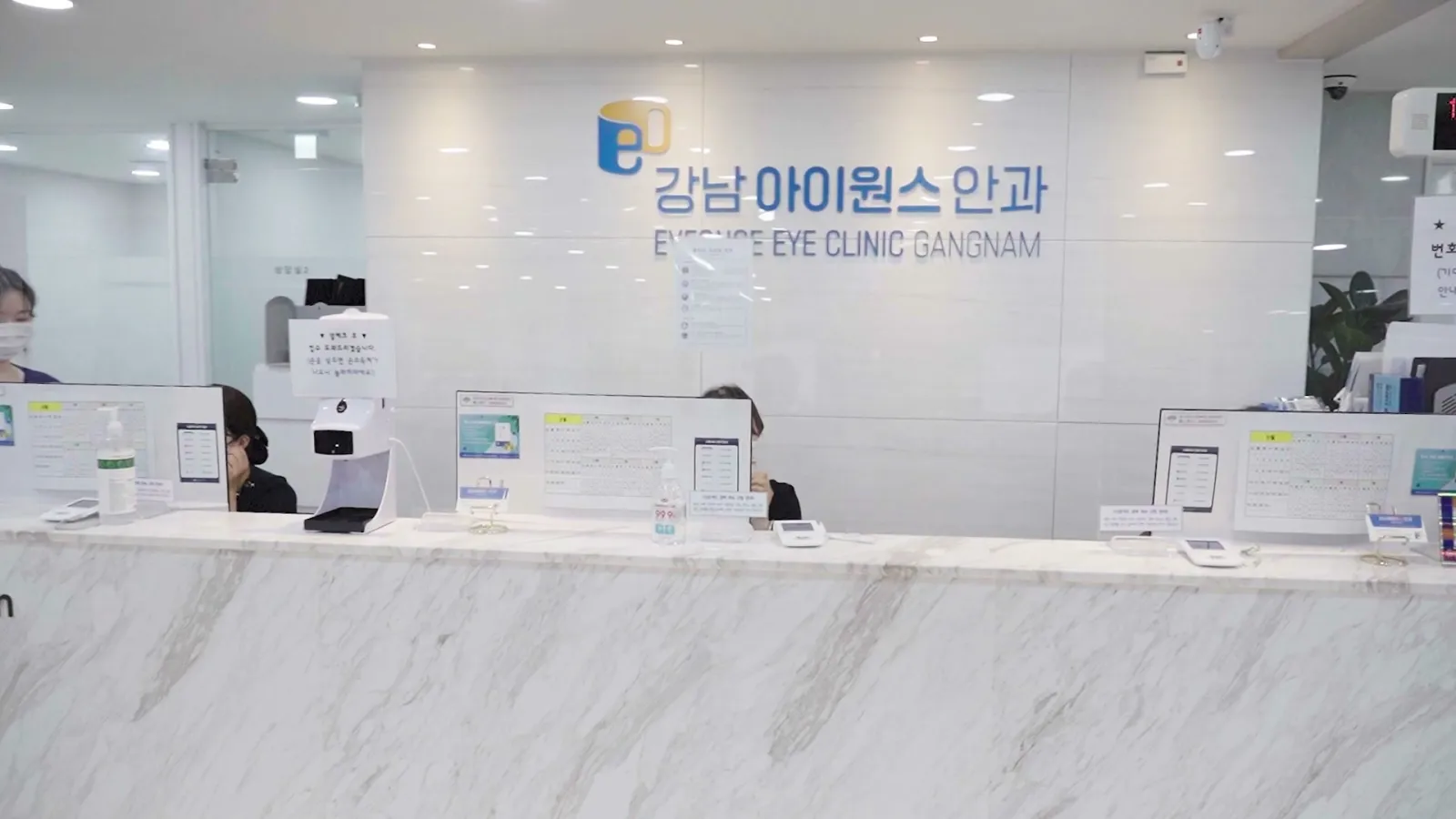
The clinic is on floors 5–6 of Duo Sinnonhyeon, 368 Sapyeong-daero, Seocho-gu, a 3-minute walk from Exit 3 of Sinnonhyeon Station (Line 9 and the Sinbundang Line). From Incheon International Airport it's roughly 60–75 minutes by taxi, and the airport railroad plus subway or the limousine bus also work. Appointments are required.
A refractive work-up typically includes the five measurements below, most of them just you resting your chin and looking at a light. Interpreters are on-site in English, Chinese, Mongolian and Thai, so you can ask what each machine is for while it's happening.
| Measurement | What it shows | Why it matters for a high prescription |
|---|---|---|
| Refraction | Your current glasses power, rechecked | Compared with your old records to see whether the number has been stable |
| Corneal thickness | The amount of tissue there is to work with | Higher prescriptions need more tissue removed by laser |
| Corneal shape (topography) | The curvature map of the front of the eye | An irregular pattern can signal a weaker cornea |
| Pupil size in dim light | How wide the pupil opens at night | Larger pupils may add to night halos in some eyes |
| Tear film | How well the eye surface stays wet | Dry eyes can get drier after laser |
For anyone for whom ICL is an option, the work-up here adds a 3D analysis of the eye: axial length, anterior chamber depth (the space in front of the natural lens), corneal curvature and astigmatism. Those numbers size the lens one-to-one for your eye. Many refractive work-ups also use dilating drops at some point, which blur near vision for a few hours, so don't plan to read contracts that afternoon.
When I read your scans, corneal thickness alone rarely ends the conversation. What I weigh is thickness against the amount of tissue your prescription would take: a strong prescription on a cornea that is only average leaves a smaller margin than the same cornea at -3 D. A topography map that looks uneven, or very different between the two eyes, is a reason to repeat the scan before deciding anything, because a cornea that's already weak in one area is one that laser reshaping can make weaker.
A clinic in Korea might not say yes. When two surgeons look at the same eyes and disagree, the difference is usually the method being considered, not the eyes. A no to flap LASIK can sit right next to a yes to LASEK, which needs no flap, or to ICL, which removes no corneal tissue at all.
Other reasons the answers differ: the earlier measurements were taken while you were still wearing lenses, your prescription has shifted since, or the two clinics offer different procedures. None of that means your first surgeon was wrong. If the fresh numbers here point the same way, you'll hear the same answer from me, with the reasons laid out.
I do the diagnosis, the surgery and the follow-up myself. That matters most for people who have already been told no: the doctor who reads your scans on exam day is the same one who would answer for the result years later, so there is no reason to stretch a borderline case into a yes. A no from me comes with the numbers behind it.
Four paths come out of the exam, and the table below is how they usually line up with eye types. The final choice belongs to your measurements, not to the table.
| Path | How it works | Usually considered for |
|---|---|---|
| LASIK | Ziemer FEMTO Z8 makes a thin flap; the WaveLight EX500 reshapes beneath it | Corneas thick enough for a flap; mild-to-moderate myopia |
| LASEK | Surface layer loosened, cornea reshaped directly by the EX500, no flap | Thinner corneas, contact sports, sensitive eyes |
| SMILE LASIK | Flapless keyhole laser; a thin disc of tissue removed through a small incision | Myopia and astigmatism, active lifestyles, dry-eye concern |
| ICL | EVO Aqua ICL (CentraFLOW) placed behind the iris; no corneal tissue removed | High myopia, thin corneas, dry eyes, large night pupils |
Recovery differs too. LASIK and SMILE LASIK usually give functional vision within a day or two. LASEK heals gradually over the first weeks and stabilizes by month 1–3. With ICL, vision is usually clearer within a day and settles over 1–2 weeks.
The keyhole technique behind SMILE has been described in detail in the peer-reviewed literature: Reinstein and colleagues explain how the lenticule is cut inside the cornea and removed through a small incision, without creating a flap. We also offer SMILE PRO; which of the two keyhole options suits you is settled at the exam.
For high prescriptions, the row people overlook is the last one. ICL sits behind the iris and in front of your natural lens, works through a roughly 3 mm incision, and can be removed or exchanged later. Its central port keeps the eye's natural fluid flowing, so a separate iridotomy isn't needed. If laser would remove too large a share of your cornea, this is often where the conversation goes. The LASEK guide and the SMILE LASIK explainer go deeper on those two laser paths.
Every path here carries risk, and the exam exists to keep it as low as your eyes allow. The FDA's LASIK patient information lists the main ones: dry eyes, glare, halos and starbursts at night, under- or over-correction that may still leave you needing glasses, and, rarely, a loss of vision that glasses cannot fully fix.
By path:
Laser reshaping is generally not the right fit for corneas that show early signs of irregular thinning on topography, prescriptions that are still changing, or very dry eyes that haven't been treated. In those cases the realistic outcomes are "ICL instead", "not yet" or "no". Results and healing vary from person to person, and nobody can promise you a number on the eye chart.
If something feels wrong after surgery, our Lifetime Aftercare means you can come back for a re-examination at any time, with re-treatment support where it's appropriate. The exact conditions are confirmed at your consultation.
For laser vision correction, about 3–5 days is typical: exam and often surgery on day one, a check-up the next day, then the flight home. For ICL, plan on 5–7 days.
The calendar has one catch. The clinic is open Monday, Tuesday, Thursday and Friday 09:00–18:00 and Saturday 09:00–16:00, with lunch from 13:00 to 14:00, and closed on Wednesdays and Sundays. Surgery on a Tuesday or a Saturday therefore pushes the next-day check by a day, which is worth knowing before you book the return flight.
The CDC's guidance on medical tourism suggests planning follow-up care at home before you travel and taking copies of your medical records with you.
For eyes, that means keeping your exam results and drop schedule on your phone. Once home, use the prescribed drops and artificial tears for the first 1–3 months and go easy on screens early on. If you feel a foreign-body sensation or pain, see a local ophthalmologist and then contact us. For the wider trip planning, the South Korea eye surgery overview and the LASIK checklist cover the rest, and the EYEONCE home page lists every procedure we offer.
If you were told no at home, start with the two papers that matter: a photo of your prescription card and the page from that clinic's report showing corneal thickness or the topography map. Send them on WhatsApp to our English consultation team, and the in-person exam in Seoul makes the final call.
Results and suitability vary by individual. Your procedure recommendation is confirmed only through an in-person diagnostic exam.

Representative Director · Former Clinical Instructor, Dept. of Ophthalmology, Samsung Seoul Hospital · Member, Korean Society of Cataract and Refractive Surgery · Member, American Society of Cataract and Refractive Surgery
International patients share what actually happened — from their first fears to waking up the next morning without glasses.
Our patients share their stories on Google — verified, public and unfiltered. Open the map to read every review straight from the source.
Tell us your prescription and travel dates. Our English-speaking team will design your personalized plan — free of charge, no pressure.
An English-speaking eye clinic in the heart of Gangnam, Seoul — moments from Sinnonhyeon Station and easily reached from Incheon International Airport.
5–6F, Duo Sinnonhyeon, 368 Sapyeong-daero, Seocho-gu, Seoul, South Korea
+82-10-6308-0984 — English, Chinese, Mongolian & Thai
Mon, Tue, Thu, Fri 09:00–18:00 · Sat 09:00–16:00 · Lunch break 13:00–14:00 · Closed Wed & Sun
By appointment only · Registration may close early depending on the day’s schedule.
Sinnonhyeon Station (Line 9 / Sinbundang Line) — 3 min walk. Gangnam Station (Line 2) nearby.