
Korea laser eye surgery usually needs 3 to 5 days in Seoul: an exam, surgery that can often happen the same day, and a check the next morning before you fly home.
How many days does laser eye surgery in Korea really need?
Wednesdays and Sundays: plan around the closures
Stop your contact lenses before you buy the ticket
Which laser option suits a short trip?
Risks in the first days abroad, and who shouldn't have laser
Can you still see Seoul after surgery?
Who looks after your eyes once you're home?
Land in Seoul on a Wednesday evening, take the eye exam on Thursday morning, and if the measurements allow, you may be treated that same day. Friday is the next-day check. After that check, you can think about the airport. That is the minimum sequence for Korea laser eye surgery, and it is why the planning range on our site for laser vision correction is 3 to 5 days. Same-day exam and surgery, with interpreters on site in English, is what makes that sequence possible on limited leave.
If you're teaching English somewhere in Asia or saving up annual leave, with glasses around -4 or -5 D and one holiday circled on the calendar, the question is whether your days off line up with the clinic's days on. The sections below are about that fit: closures, contact lenses, which procedure your cornea allows, and what happens after you fly back.

Plan on 3 to 5 days in Seoul for LASIK, LASEK or a SMILE-based procedure. The minimum sequence is three steps: the exam, the surgery (often the same day when the numbers allow it), and a check the following day before you fly home.
The exam is where the trip is really decided. Your cornea is measured on Topcon diagnostics, your prescription is checked again, and surgery is considered only after those results are read. I handle the diagnosis, the surgery and the follow-up myself, so the person who reads your measurements is the same person you see at the next-day check.
The extra days at the 5-day end exist for practical reasons. LASEK heals more slowly than LASIK. An exam result sometimes needs repeating, for example when the cornea still looks reshaped by recent contact lens wear. And if the exam points away from laser toward ICL, the clinic's guidance for lens procedures is 5 to 7 days. For a broader overview of procedures and stays, see our starting guide to eye surgery in South Korea.
EYEONCE is closed on Wednesdays and Sundays, and Saturday hours are 09:00 to 16:00. A Saturday surgery therefore has its next-day check on Monday, which puts the earliest flight home on Monday.
The weekday hours are 09:00 to 18:00 on Monday, Tuesday, Thursday and Friday, with a lunch break from 13:00 to 14:00. Appointments are required, and registration can close early on busy days, so walking in on arrival is not a plan.
| If surgery is on | The next-day check falls on | Earliest you'd consider flying |
|---|---|---|
| Monday | Tuesday | Tuesday, after the check |
| Tuesday | Thursday (closed Wednesday) | Thursday, after the check |
| Thursday | Friday | Friday, after the check |
| Friday | Saturday (open until 16:00) | Saturday, after the check |
| Saturday | Monday (closed Sunday) | Monday, after the check |
The right-hand column assumes the doctor clears you at that check. If your vision or the surface of the eye needs another look, the flight moves, which is why a buffer day is easier than rebooking a ticket. On a short trip, a Monday, Thursday or Friday surgery keeps the check on the following day.
Contact lenses change the shape of the cornea, and the exam needs your natural shape. The clinic asks you to stop soft lenses at least 5 to 7 days before the exam, hard or RGP lenses at least 3 weeks before, and ortho-k (overnight) lenses at least 1 month before.
This is the step that most often breaks a short trip, because it starts long before the flight. If you wear contacts to teach or to work out, that means a week or more in glasses while you're still at home. The U.S. Food and Drug Administration's patient guidance sets its own windows by lens type, some of them longer, so if you can stop earlier, stop earlier.
What to pack for exam day is short:
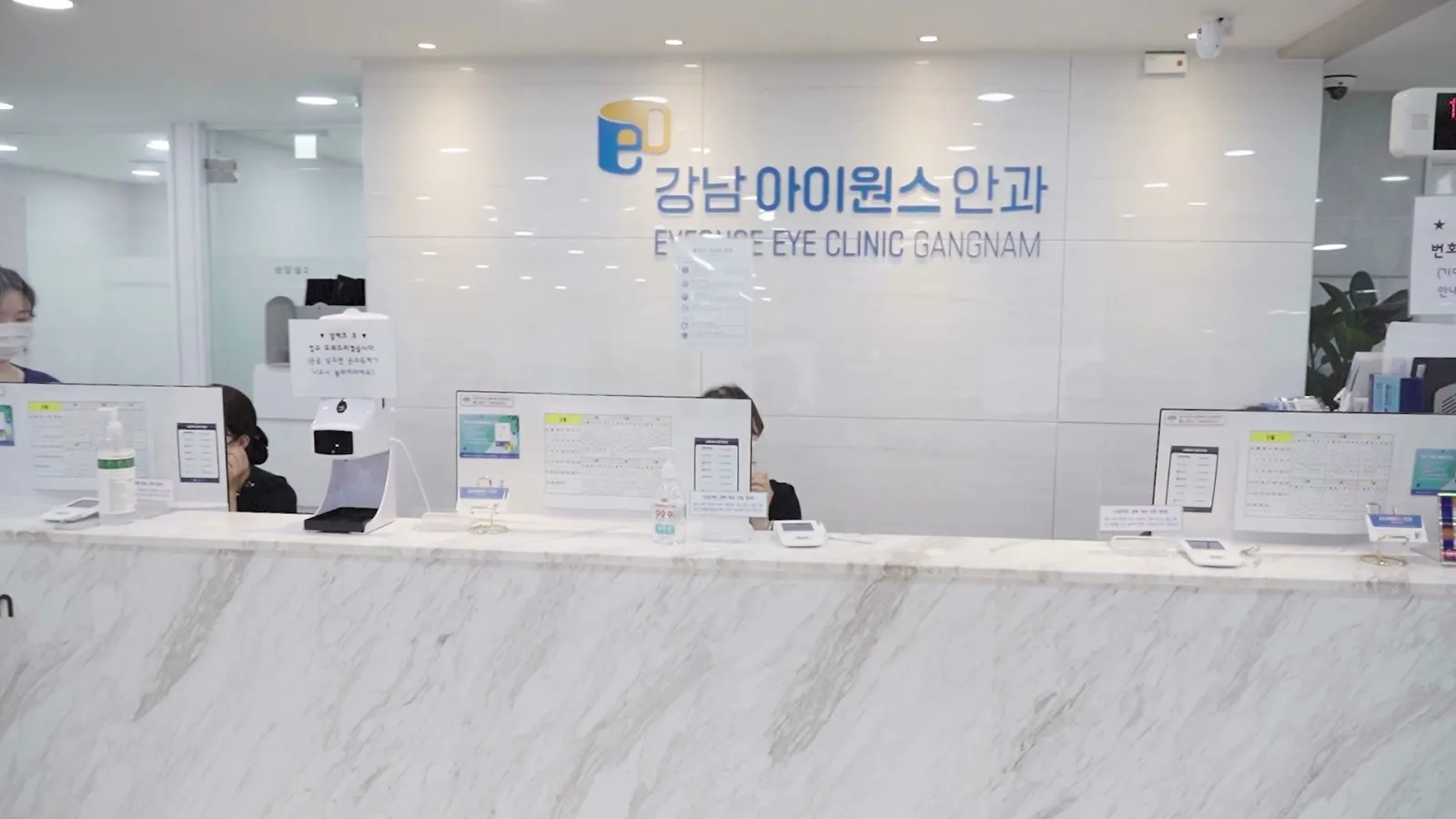
The clinic is at 5–6F, Duo Sinnonhyeon, 368 Sapyeong-daero, Seocho-gu. From Incheon Airport you can come by taxi, by AREX plus the subway, or by limousine bus; the clinic provides directions for each.
The one your cornea allows. Trip length can break a tie between two suitable procedures, but it shouldn't pick a procedure your measurements argue against.
| Option | Early days | Usually considered for |
|---|---|---|
| LASIK (flap) | Vision often improves within hours; light activity the next day | Healthy corneas of adequate thickness, mild to moderate myopia |
| LASEK (no flap) | Discomfort and light sensitivity for a few days, a bandage lens, stable by 1 to 3 months | Thinner corneas, contact sports, sensitive eyes |
| SMILE LASIK / SMILE PRO (no flap) | Clearer vision commonly noticed from the next day | Myopia and astigmatism where the exam supports a lenticule procedure |
LASIK and LASEK here are performed with the Ziemer FEMTO Z8 femtosecond laser and the WaveLight EX500 excimer laser; the difference is what happens to the cornea. LASIK lifts a flap and reshapes the tissue beneath it. LASEK loosens the surface layer, treats beneath it and lets it heal in place.
SMILE PRO corrects myopia and astigmatism through an incision of roughly 2 to 4 mm, without a flap. A review of the SMILE technique by Reinstein and colleagues in Eye and Vision describes the principle: a lens-shaped piece of tissue is shaped inside the cornea and removed through that small opening. Our pages on LASEK and who it suits and how SMILE LASIK differs go further into each.
When the exam points to LASEK and the trip only has four days, I'd change the trip, not the procedure. Choosing a flap because it fits a calendar, when the cornea is better suited to surface treatment, puts the schedule ahead of the eye.
Whether your corneas point to LASIK, LASEK or a lenticule procedure is something only your own measurements can answer, and that is also what decides whether 3 days is enough or 5 is wiser.
Dry, gritty eyes, light sensitivity, vision that drifts during the day and glare or halos around lights at night are the effects people most commonly notice early on. They usually ease over weeks to months, but they are the reason the next-day check is not optional.
The FDA's patient information lists further risks worth knowing before you book: some people are under- or over-corrected and may still need glasses for some tasks or a later enhancement, dry eye can persist, and night glare can last in a minority. With LASIK, rubbing the eye in the early period can disturb the flap. Infection is uncommon, and its early signs (worsening pain, redness, falling vision) are the reason to message the clinic right away instead of waiting.
Laser correction is not the answer for every eye. A prescription that is still changing, a cornea that is too thin or irregular for laser, or very dry eyes can all lead the exam elsewhere. For high myopia, thin corneas or dry eyes, ICL with the EVO Aqua ICL (CentraFLOW) may be considered instead, and sometimes the right result of an exam is to wait. Every eye responds differently, and the in-person exam decides suitability.
Lightly, yes, and mostly from the day after. After LASIK or a SMILE procedure many people feel ready for slow walking days, with sunglasses and a few rules. After LASEK, plan for a quiet first day or two.
The rules protect the surface of the eye:
The flight home is usually uneventful, but cabin air is dry. Keep your drops in your carry-on and use them on the schedule you were given rather than when you remember.
Three parties: you, an ophthalmologist near where you live for any in-person checks, and EYEONCE under its Lifetime Aftercare, which covers re-examination at any time and support for re-treatment when it is needed. The specific conditions are confirmed at your consultation.
The U.S. Centers for Disease Control and Prevention's medical tourism page advises travelers to carry copies of their records and to arrange follow-up care at home before they leave. For eye surgery, that means asking for the name of the procedure and your measurements so a local doctor can read them. If something feels wrong once you're back, the first step under Lifetime Aftercare is a WhatsApp message; a re-examination is reviewed from there.
Language is less of a hurdle than people expect. EYEONCE is registered with the Seoul government as a clinic for international patients, interpreters are on site for English, Chinese, Mongolian and Thai, and WhatsApp consultations run in those same languages.
Dryness is the after-effect I'd most want to hear about early, even from another country, because it is far easier to manage at week two than at month six. Dry eye is also the subject of the Textbook of Dry Eye (2019), which I co-authored.
If you already have dates in mind, send them on WhatsApp together with a photo of your latest glasses prescription. Our English-speaking team will build a schedule around them, and if your numbers point to a longer stay or a different procedure, that's better to know before you buy a flight. You can also read what to check first before LASIK in Korea or start from the EYEONCE home page.
Results and suitability vary by individual. Your procedure recommendation is confirmed only through an in-person diagnostic exam.

Representative Director · Former Clinical Instructor, Dept. of Ophthalmology, Samsung Seoul Hospital · Member, Korean Society of Cataract and Refractive Surgery · Member, American Society of Cataract and Refractive Surgery
International patients share what actually happened — from their first fears to waking up the next morning without glasses.
Our patients share their stories on Google — verified, public and unfiltered. Open the map to read every review straight from the source.
Tell us your prescription and travel dates. Our English-speaking team will design your personalized plan — free of charge, no pressure.
An English-speaking eye clinic in the heart of Gangnam, Seoul — moments from Sinnonhyeon Station and easily reached from Incheon International Airport.
5–6F, Duo Sinnonhyeon, 368 Sapyeong-daero, Seocho-gu, Seoul, South Korea
+82-10-6308-0984 — English, Chinese, Mongolian & Thai
Mon, Tue, Thu, Fri 09:00–18:00 · Sat 09:00–16:00 · Lunch break 13:00–14:00 · Closed Wed & Sun
By appointment only · Registration may close early depending on the day’s schedule.
Sinnonhyeon Station (Line 9 / Sinbundang Line) — 3 min walk. Gangnam Station (Line 2) nearby.