
SMILE PRO corrects myopia and astigmatism by removing a thin lenticule through a keyhole incision under 4 mm, with no flap. Surgery takes about 10–15 minutes; your corneal exam decides whether it fits.
What SMILE PRO actually does
Six questions, and what to listen for in the answers
What will the consultation ask about you?
How a surgeon reads your corneal map before saying yes
What decides the cost of SMILE PRO?
Which eyes does SMILE PRO not suit, and what are the risks?
How does exam day connect to surgery day on a short trip?
What happens if something feels wrong after you fly home?
Wondering whether SMILE PRO is right for your eyes, and what the exam has to show before anyone says yes?
Read this before you book flights or pick a date.
After reading, you will know what the corneal exam measures, which eyes SMILE PRO does not suit and what the risks are, what decides the cost, and six questions to ask in any consultation room.
I'm Dr. Baek Dong-won, Representative Director of EYEONCE in Gangnam, where English-speaking staff and same-day surgery are part of how we work with people travelling to Seoul. I wrote this because many people assume the choice of procedure comes first, when your cornea's measurements decide it.
In short, SMILE PRO corrects nearsightedness and astigmatism through a keyhole incision under 4 mm, with no corneal flap. Whether it fits you is settled at the exam.
SMILE PRO is flapless laser vision correction: a lenticule is shaped inside your cornea and lifted out through a 2–4 mm opening, so the front curve of the eye changes and light focuses where it should. It treats myopia and astigmatism.
The technique underneath it is small incision lenticule extraction, known internationally as ReLEx SMILE. A 2014 review in Eye and Vision by Reinstein, Archer and Gobbe lays out its history and principle, and explains why leaving the front of the cornea without a flap has drawn interest for corneal strength and for disturbing fewer corneal nerves, the ones involved in tear production.
EYEONCE offers SMILE PRO as a newer version of that same lenticule approach, alongside SMILE LASIK. Both are flapless keyhole procedures with a 2–4 mm incision.
SMILE LASIK keeps the same flapless design and its lower dry-eye risk compared with traditional LASIK, and the exam decides which one is planned for your eyes. If you want the longer comparison with flap-based surgery, this page on how SMILE LASIK differs from traditional LASIK covers it.
Listen for a measurement from your own exam, or a reason tied to your own life. A confident "you'll be fine" before anyone has measured your cornea is the answer to push back on, politely.
| Question | Why it matters | Listen for something like |
|---|---|---|
| Is my cornea thick and regular enough? | Removing a lenticule takes tissue, and an irregular shape can signal a weaker cornea | "Your thickness is this, both maps look even, and this much stays untouched after correction" |
| Is my prescription in range and stable? | A prescription that is still changing will keep changing after surgery | "Your last two prescriptions match, and your correction sits inside the treatable range" |
| How is my tear film? | Dryness can feel worse for a while after any laser surgery | "Your tears look stable" or "let's treat the dryness first and measure again" |
| Why this procedure and not another? | Thin corneas, very high prescriptions or contact sports can point elsewhere | A reason tied to your numbers, plus what the alternative would be |
| Who examines, operates and follows up? | The person reading your map is the one planning your correction | A name, not a department |
| What happens after I fly home? | An enhancement after SMILE-type surgery works differently, because there is no flap to lift | Whom to contact, and how a re-examination is arranged |
Ask the fourth question even if you arrived set on SMILE PRO. Forum threads tend to treat it as the default upgrade, and plenty of eyes are better served by LASEK or ICL. Hearing why your eyes fit, or don't, protects you from feeling sold to.
You can ask all of this in your own language. EYEONCE is a Seoul-government-registered clinic for international patients, with in-house interpreters on site in English, Chinese, Mongolian and Thai, and WhatsApp consultation is offered in English, Chinese, Mongolian and Thai.
Expect questions about your contact lenses, your work, your sport and your health history. Each answer can change the plan, so answer them plainly.
Bring your glasses and any prescription records, and skip eye makeup on exam day.
Three things on the map carry most of the decision: overall thickness, the pattern of curvature across the front surface, and how the back surface behaves. A cornea that is thick but unevenly steep can be a bigger concern than a thinner one with a clean, even pattern.
On a topography map, a healthy cornea with astigmatism usually shows a fairly symmetric "bow tie". What makes a surgeon slow down is asymmetry: one half steeper than the other, steepening low on the cornea, or a back surface that bulges forward more than expected. Those patterns can be early signs of keratoconus, a condition in which removing tissue may weaken the cornea further. Comparing the right eye with the left helps too; two eyes that look very different deserve a closer look.
Thickness is read alongside the planned correction. The higher the prescription, the thicker the lenticule, so surgeons estimate the tissue that will remain untouched beneath the treated layer before agreeing to any laser plan.
Stability is the third piece. Many refractive surgeons want prescriptions that have held steady for about a year before operating. In my clinic, the measurements come from Topcon diagnostics, and if you want to see how prescription size and astigmatism push toward one procedure or another, this page on how the numbers decide your procedure goes deeper.
I examine, operate and follow up myself, so the person reading your map is the person who will plan and perform your correction and see you the next morning. If something on the map makes me hesitate, I would rather say "not SMILE PRO" at the exam than find a reason later. Dry eye is also a subject I co-authored a textbook on (Textbook of Dry Eye, 2019), which is why I think an unstable tear film deserves a conversation before any laser, flapless or not.
If you already have a recent prescription or an exam report from home, keep a photo of it on your phone.
Say you are 29, your glasses are around -5.00 in both eyes with mild astigmatism, and you can be in Seoul for only a few days. I would not start from the procedure name. I would first ask how long you have worn contact lenses and when you last took them out, because lenses can change the corneal shape we measure. Then I would look at the corneal map for thickness and regularity, check that your prescription has been stable, and look at your tear film.
If those readings are in a comfortable range, SMILE PRO becomes a reasonable option to discuss. If the cornea is thin or irregular, or the tear film is poor, I would talk with you about SMILE LASIK or ICL instead. The exam sets the order of the conversation.
The cost depends on your eyes and your plan, not on a single fixed item. The main factors are which method the exam shows is right for you (SMILE PRO, SMILE LASIK or another option), how much correction each eye needs, and whether the two eyes differ. Extra tests or a second visit, the number of days you stay in Seoul, and the follow-up you need after you fly home also count. Because these change from person to person, a general answer would mislead you.
To get the figure for your case, send your prescription and a photo of your eye report on WhatsApp and ask for it there.
SMILE PRO carries the risks of laser vision correction in general: dryness, glare and halos at night, temporary haze, a result slightly over or under target that may need enhancement, and rare serious problems such as infection or corneal weakening. Not every eye should have it.
In the first weeks, the after-effects are similar to other laser procedures. The U.S. Food and Drug Administration's patient page on what to expect after laser surgery describes discomfort, hazy or blurry vision and sensitivity to light in the early period. My clinic's SMILE PRO FAQ notes that some fluctuation or temporary haziness in the first 1–3 months is normal as the cornea heals.
One issue is specific to the lenticule technique: if an enhancement is ever needed, there is no flap to lift, so the method differs from LASIK retreatment.
SMILE PRO is usually not the right plan if:
There are alternatives for some of these eyes. In my clinic, LASEK is the preferred option for thinner corneas, small eyes or contact-sport lifestyles, and ICL is an option for high myopia, thin corneas, dry eyes or prescriptions outside the range for laser. Your own exam decides which, if any, fits.
If your exam results are suitable, exam and surgery can often happen on the same day, followed by a next-day check-up before you fly. For laser vision correction, a stay of about 3–5 days is typical at my clinic.
Check the weekday before you book.
A surgery on Tuesday or Saturday has no clinic day directly after it. If you want the check-up the morning after, aim for a Monday, Thursday or Friday surgery date; with a Tuesday or Saturday date, the next open day is Thursday or Monday, so keep that day in Seoul before your flight.
We are on floors 5–6 of Duo Sinnonhyeon, 368 Sapyeong-daero, Seocho-gu, a 3-minute walk from Exit 3 of Sinnonhyeon Station (Line 9 and Sinbundang Line), and roughly 60–75 minutes by taxi from Incheon International Airport. Arrange a companion or a ride for surgery day.
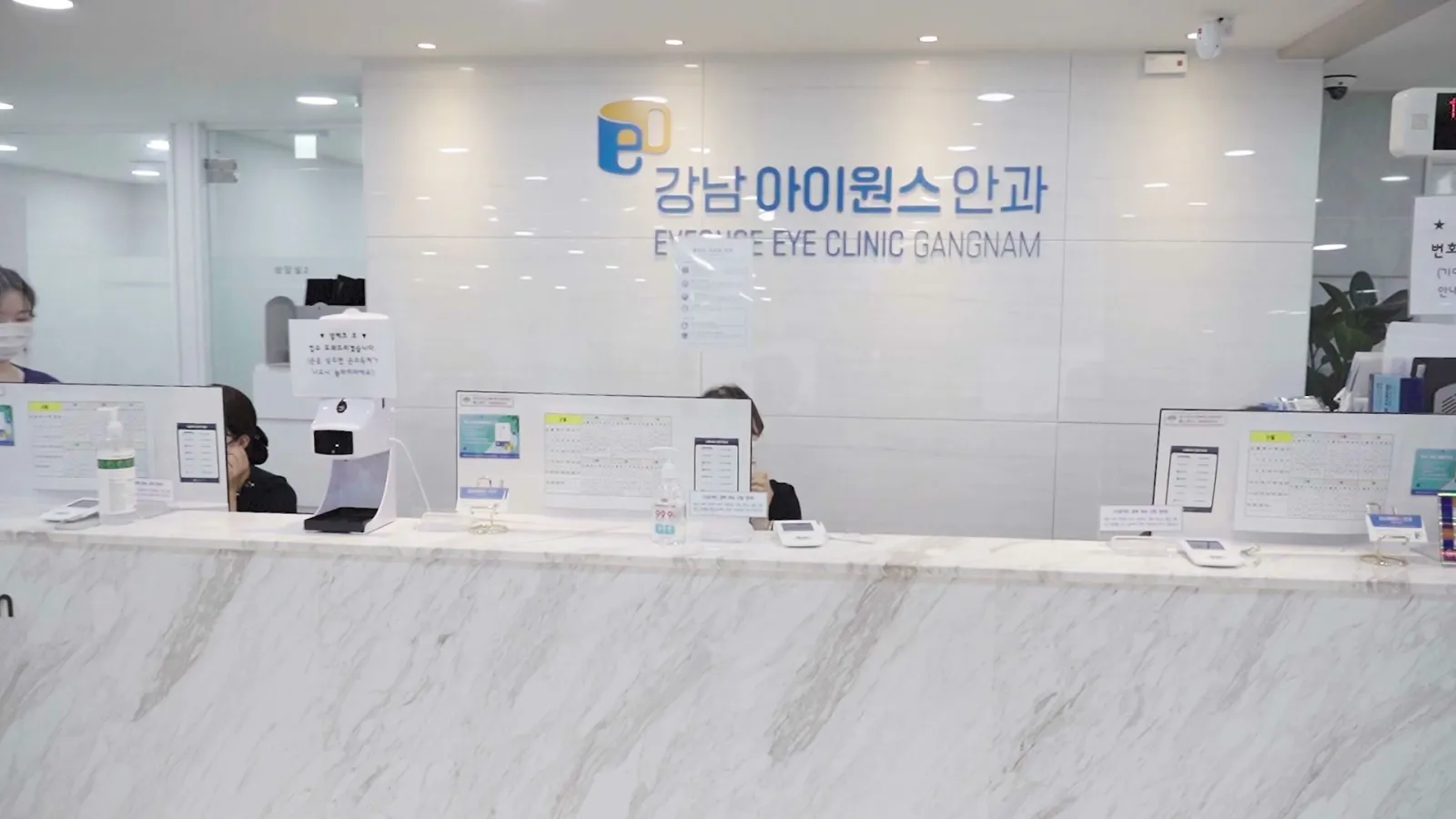
During the procedure, numbing drops mean most people describe pressure rather than pain. Afterward, my instructions are to avoid rubbing your eyes, wear the protective shields while sleeping for the first few nights, wear sunglasses outdoors, skip eye makeup for about two weeks, and stay out of pools, saunas and steam rooms for about a month. For the week-by-week version, see when daily life really returns after SMILE LASIK.
Contact us at any time. EYEONCE's lifetime aftercare covers a detailed re-examination and, where appropriate, re-treatment; the exact conditions are confirmed at consultation. If you feel pain or a foreign-body sensation, see a local ophthalmologist first, then contact us.
Before you leave Seoul, ask for your key measurements and surgery details in a form your ophthalmologist at home can read. A doctor seeing your eyes for the first time works much faster with the original thickness and prescription in hand. If you are still comparing options more broadly, what to check before laser eye surgery in Korea lists the wider questions.
If you have a recent prescription or eye exam report, send one photo of it on WhatsApp together with the dates you are considering, and ask this: "Based on these numbers, which procedure would the exam most likely point to, and what would you need to check first?" One photo is enough to start, and you can ask before booking anything. The consultation is a consultation, so asking costs you nothing but a few minutes.
Results and suitability vary by individual. Your procedure recommendation is confirmed only through an in-person diagnostic exam.

Representative Director · Former Clinical Instructor, Dept. of Ophthalmology, Samsung Seoul Hospital · Member, Korean Society of Cataract and Refractive Surgery · Member, American Society of Cataract and Refractive Surgery
International patients share what actually happened — from their first fears to waking up the next morning without glasses.
Our patients share their stories on Google — verified, public and unfiltered. Open the map to read every review straight from the source.
Tell us your prescription and travel dates. Our English-speaking team will design your personalized plan — free of charge, no pressure.
An English-speaking eye clinic in the heart of Gangnam, Seoul — moments from Sinnonhyeon Station and easily reached from Incheon International Airport.
5–6F, Duo Sinnonhyeon, 368 Sapyeong-daero, Seocho-gu, Seoul, South Korea
+82-10-6308-0984 — English, Chinese, Mongolian & Thai
Mon, Tue, Thu, Fri 09:00–18:00 · Sat 09:00–16:00 · Lunch break 13:00–14:00 · Closed Wed & Sun
By appointment only · Registration may close early depending on the day’s schedule.
Sinnonhyeon Station (Line 9 / Sinbundang Line) — 3 min walk. Gangnam Station (Line 2) nearby.