
Choosing among Seoul cataract surgeons comes down to who operates, which scans come first and who follows up once you are home. Four measurements decide your lens and your trip length.
What should you check about any surgeon before booking a flight?
Which measurements decide your lens and your surgery plan?
Lens choice follows your daily life, not only your prescription
How many days should you plan in Seoul for cataract surgery?
Who looks after you once you are home?
What are the risks of cataract surgery, and who should hold off?
If glasses-free distance vision is also on your list
Choosing between Seoul cataract surgeons comes down to three things you can check before flying: who operates, what gets measured first, and who you can reach once you are home. Most travelers worry about the last one, because a problem on day ten is hard to solve from another time zone. At EYEONCE Eye Clinic in Gangnam, I personally guide each patient from diagnosis through surgery and follow-up, and the follow-up is structured so that care continues after surgery.
Below is the checklist I would hand a friend, then a plan for how many days to set aside.
Send the dates you are considering on WhatsApp. The English-speaking team handles scheduling and travel questions, so you can plan around your flights before you book them.
Check four things: who operates, what is measured before surgery, which lenses are on offer, and what follow-up looks like after you fly. A surgeon who answers all four in plain English has done the groundwork you need.
| Check | What to ask | Why it matters |
|---|---|---|
| Who operates | Is the doctor who examines you the one operating? | Handoffs are where details get lost |
| Measurements | Which scans come before any lens is suggested? | The lens choice rests on them |
| Lens range | Monofocal, EDOF, trifocal, toric? | Night driving and reading needs differ |
| Aftercare | What if you need a re-check after flying home? | Follow-up is the hard part from abroad |
At EYEONCE, Dr. Baek Dong-won, the Representative Director, personally guides each patient from diagnosis through surgery and follow-up. His listed background includes a post as Clinical Instructor in the Department of Ophthalmology at Samsung Seoul Hospital, and membership in the Korean Society of Cataract and Refractive Surgery and the American Society of Cataract and Refractive Surgery. The clinic is registered with the Seoul government for international patients, with in-house interpreters on site in English, Chinese, Mongolian and Thai.
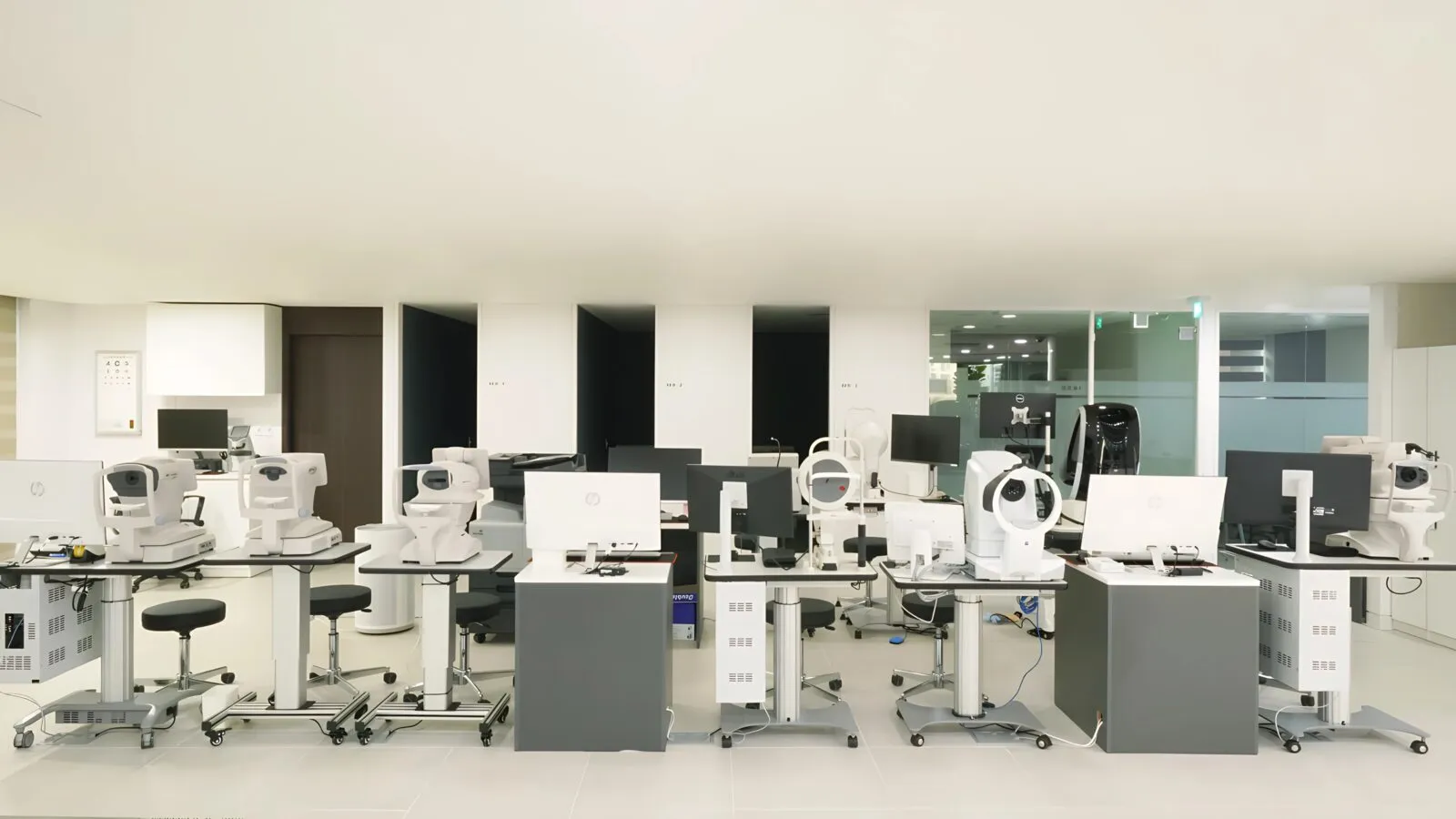
Corneal topography, pachymetry, OCT scanning, and automated refraction with keratometry are the four. EYEONCE's diagnostics room runs Topcon imaging stations for all of them, and the eye is mapped before any procedure is recommended.
Topography shows the shape of the cornea.
Pachymetry measures corneal thickness. It matters most for laser vision correction, but it also gives the surgeon a baseline for the whole front of the eye.
OCT scans the structure of the cornea and retina. A retinal condition can limit how sharp vision becomes after the cloudy lens is removed, so this scan sets realistic expectations rather than a promise.
Automated refraction and keratometry supply the numbers behind lens power and the amount of astigmatism. If you have scans or reports from an eye doctor at home, bring the files or photos. They give the Seoul team a second set of numbers to compare against.
Four factors choose the lens: where you want your vision focused, whether astigmatism needs correcting, how much night glare you will tolerate, and how much you want to be free of glasses. EYEONCE's consultation maps all four before a lens is suggested.
The range on the clinic's equipment page includes monofocal, extended-depth-of-focus and trifocal lenses, with toric versions for astigmatism. Named options include Alcon's Clareon PanOptix and Vivity, PhysIOL's FineVision and FineVision HP, and Johnson & Johnson's Symbiose, Synergy and Lisa tri. The American Academy of Ophthalmology describes the same families of lens implants and why the choice differs between people.
If you drive at night, say so early. Multifocal designs can bring more glare or halos in some eyes, which is a trade-off for less dependence on glasses.
For lens procedures the clinic usually recommends a stay of 5 to 7 days. Surgery itself runs roughly 10 to 20 minutes per eye, and recovery before you leave the clinic is often complete within a few hours.
The calendar needs more care than the surgery. EYEONCE is open Monday, Tuesday, Thursday and Friday from 09:00 to 18:00 and Saturday from 09:00 to 16:00, with a lunch break from 13:00 to 14:00. Wednesdays and Sundays are closed, and appointments are required. A week in Seoul that spans a Wednesday and a Sunday has fewer clinic days than the calendar suggests, so check-ups cannot be placed on those days.
Aftercare at home is concrete: an eye shield during sleep for a week, and no strenuous exercise for a month.
If both eyes have cataracts, the National Eye Institute explains that surgery is usually done on one eye at a time. Ask whether your plan covers one eye or both on this trip.
My view is that the follow-up plan deserves as much attention as the lens. A well-chosen lens in an eye nobody can re-check is a worse deal than the reverse. Settle who you can reach, and how, before the flight rather than after it.
EYEONCE lists lifetime aftercare: re-checks at any time and support for re-treatment where needed, with the details confirmed at consultation. Questions in the first weeks go to the English-speaking WhatsApp team, which also handles Chinese, Mongolian and Thai.
The CDC's medical tourism guidance advises arranging follow-up care before you travel. In practice, that means asking the clinic which records to carry home, and finding a local ophthalmologist you can see for routine checks.
Sudden vision loss, a curtain or shadow across your sight, new flashes or floaters, or pain that keeps getting worse need a local emergency eye service the same day. Do not wait for a WhatsApp reply in those cases.
Send your latest prescription photo and your dates on WhatsApp, and ask the one question that worries you most about the weeks after you fly.
Cataract surgery is common and generally well tolerated, but it carries risks: infection, bleeding, swelling, retinal detachment, and clouding of the capsule behind the new lens.
Multifocal lenses add their own trade-off, glare and halos at night. Other eye disease, such as retinal problems or glaucoma, can limit how much vision improves.
EYEONCE treats age-related cataracts and also diabetic, congenital, traumatic and secondary types. Cataract screening is advised from your 50s, earlier if you notice glare, halos or clouding. Results and recovery differ from person to person, and the in-person exam decides whether surgery and which lens suit your eyes.
Cataract is one of several reasons people look at eye clinics in Korea. The overview of eye surgery in South Korea maps the procedures EYEONCE offers, so you can see where your case sits.
Readers whose question is laser correction can read who LASEK is for. The SMILE LASIK guide explains what makes the flapless approach different. For travel planning, the SMILE LASIK recovery timeline shows when daily life resumes after laser correction.
Before you choose among Seoul cataract surgeons, photograph your latest glasses prescription or any cataract exam report, then add the dates you can be in Seoul and the one thing worrying you most.
Results and suitability vary by individual. Your procedure recommendation is confirmed only through an in-person diagnostic exam.

Representative Director · Former Clinical Instructor, Dept. of Ophthalmology, Samsung Seoul Hospital · Member, Korean Society of Cataract and Refractive Surgery · Member, American Society of Cataract and Refractive Surgery
International patients share what actually happened — from their first fears to waking up the next morning without glasses.
Our patients share their stories on Google — verified, public and unfiltered. Open the map to read every review straight from the source.
Tell us your prescription and travel dates. Our English-speaking team will design your personalized plan — free of charge, no pressure.
An English-speaking eye clinic in the heart of Gangnam, Seoul — moments from Sinnonhyeon Station and easily reached from Incheon International Airport.
5–6F, Duo Sinnonhyeon, 368 Sapyeong-daero, Seocho-gu, Seoul, South Korea
+82-10-6308-0984 — English, Chinese, Mongolian & Thai
Mon, Tue, Thu, Fri 09:00–18:00 · Sat 09:00–16:00 · Lunch break 13:00–14:00 · Closed Wed & Sun
By appointment only · Registration may close early depending on the day’s schedule.
Sinnonhyeon Station (Line 9 / Sinbundang Line) — 3 min walk. Gangnam Station (Line 2) nearby.