
Yes. LASIK eye surgery can fix astigmatism when it is regular, stable and comes from the cornea. Irregular shapes such as keratoconus are the main exception, and only a corneal map shows which kind you have.
Can LASIK correct astigmatism, or only nearsightedness?
The four numbers that decide it
What does irregular astigmatism mean for laser candidacy?
Where your astigmatism comes from changes the plan
Which method fits: flap, surface or small incision
What decides the cost of laser surgery for astigmatism?
What are the risks of treating astigmatism with a laser?
Getting an accurate reading before you fly
Toric contacts that rotate and blur by mid-afternoon make you ask: can lasik eye surgery fix astigmatism? Read on before you book or decide anything.
After this post you will know what decides whether your astigmatism can be treated, what the cost depends on, what review threads claim compared with medical fact, and which method fits, so you can decide whether a trip is worth planning.
Hello, I'm Dr. Baek Dong-won, Representative Director of EYEONCE.
EYEONCE is a vision-correction clinic in Gangnam, Seoul.
People often write to me because they assume the cylinder number on a glasses prescription settles the question, when the shape of the cornea on the map usually matters more.
For most eyes the answer is yes, if the astigmatism is regular and stable. LASIK flattens the steeper direction of the cornea in the same treatment that corrects nearsightedness.

LASIK treats nearsightedness, farsightedness and astigmatism in one pass. The excimer laser removes more tissue along one axis than the other, so the cornea ends up closer to evenly curved. The U.S. National Eye Institute describes surgery for astigmatism in exactly these terms: it changes the shape of the cornea so it can focus light correctly.
What a standard laser treatment can't do is even out a cornea whose shape has no regular pattern. So the first question about your own eyes is whether your astigmatism is regular or irregular, and the second is where it comes from.
Cylinder, axis, topography pattern and stability. Your glasses prescription gives the first two, a corneal scan gives the third, and your old prescriptions give the fourth. Corneal thickness sits behind all of them, because correcting astigmatism uses some of it.
| What you'll see | Example | What it tells the surgeon |
|---|---|---|
| Cylinder (CYL) | -1.75 | Strength of the astigmatism in diopters |
| Axis | 180 | Its direction, from 0 to 180 degrees |
| Topography pattern | symmetric "bow tie" | Whether the shape is regular enough for standard treatment |
| Change over the past year | none | Whether the target has stopped moving |
A prescription written as -3.00 -1.75 x 180 means 3 diopters of nearsightedness and 1.75 diopters of astigmatism at an axis of 180 degrees. Some doctors write the same eye in plus-cylinder form, -4.75 +1.75 x 090. It looks like a different eye, but the optics are identical, so check the sign of the cylinder before you decide two reports disagree.
The NEI notes that mild astigmatism may not need treatment at all. In practice a small cylinder is rarely the reason someone has surgery; it gets corrected along with the sphere when they do. There's no single upper cutoff that applies everywhere. Each laser has its own treatment range, and the real limit is often tissue: high myopia plus high cylinder removes more cornea. When that combination gets large for the thickness available, lens-based options enter the conversation, which is covered in how we assess high myopia and astigmatism together.
The treatment has to line up with your axis. A small misalignment leaves some astigmatism behind, and the eye can rotate slightly when you go from sitting upright at the exam to lying flat under the laser. Refractive lasers and surgeons use reference marks or eye tracking to account for that, which is why the axis on your report matters as much as the cylinder.
A corneal topography scan maps curvature across the whole surface. Regular astigmatism shows up as a symmetric bow tie: two matching lobes of steeper curvature on opposite sides of the center. The lobes sit along the steep meridian, which on a minus-cylinder prescription is 90 degrees from the written axis, so -1.75 x 180 usually shows up as a vertical bow tie. Diagnostics at EYEONCE include Topcon equipment.
Three things on a map make a surgeon slow down: one lobe clearly steeper than the other, steepening concentrated in the lower cornea, and a map whose astigmatism doesn't match the glasses prescription.
The U.S. Food and Drug Administration lists a change in your contact lens or glasses prescription within the past year as a reason LASIK may not be right for you. Old glasses, old prescription cards and photos of past exam slips all help here.
Say you wear toric contacts, your glasses read about -3.00 SPH with -2.00 CYL, and you have a corneal map from an optician. Before anything else, I would check whether the map shows a symmetrical bow-tie pattern and whether your prescription has stayed the same for a year or more. If both are true, your astigmatism is regular and stable, and laser correction is usually worth discussing.
If the map shows an uneven pattern, I would slow down and look at the cornea's thickness and shape before talking about any method. You may also have read online that astigmatism always returns after surgery or that it can never be treated. Neither claim holds as a blanket statement; what matters is what your own numbers show.
Usually it means standard LASIK is off the table until the cause is known. Irregular astigmatism comes from things like keratoconus, corneal scars, previous eye surgery, or a tear film so uneven that the map itself is distorted.
Keratoconus is the serious one. Removing tissue from a cornea that is already weakening is the concern. This is also why a person with "only a little astigmatism" can be told no: the amount was small, but the pattern was the problem.
Dry eye is the opposite case. A patchy tear film scatters the scanner's reflections, so the map can look irregular when the cornea underneath is fine. Treating the surface and measuring again can change the picture completely.
Dry eye is a subject I've spent a lot of time on, including as a co-author of the Textbook of Dry Eye (2019), and it changes how I read astigmatism. A map taken on a dry surface can suggest an irregular cornea that isn't there, or exaggerate the cylinder. I'd rather repeat a measurement once the tear film has been treated than plan a laser treatment from a reading I don't trust.
Not sure whether your map shows a regular bow tie? A photo of the topography printout is the thing to send.
A laser can only treat the astigmatism that lives in the cornea. Your glasses measure total astigmatism, from the cornea and the natural lens inside the eye together, while topography measures the cornea alone. When the two numbers roughly match, the cornea is the source and the laser has a clear target.
When they don't match, part of the astigmatism comes from the lens. For people in their forties and beyond, or anyone with early lens clouding, the lens itself sometimes becomes the better place to correct it: the clinic's cataract service offers toric intraocular lenses, which correct astigmatism at the time the clouded lens is replaced. The decision depends on your measurements, and how the numbers point to a procedure walks through those forks.
All three correct regular astigmatism. Which one fits is decided by your cornea, not by the astigmatism alone.
The clinic's laser equipment is the Ziemer FEMTO Z8 femtosecond laser and the WaveLight EX500 excimer laser. Which method a given cornea suits comes from thickness, the topography pattern, dryness and how you live, and the exam is where that is settled.
The cost depends on your eyes more than on the word "astigmatism". The method matters first, because a flap, surface or small-incision treatment each involves different steps. The amount of correction and the shape of your cornea affect how the treatment is planned. Extra tests or a second visit may be needed if your corneal map is borderline. The number of days you stay in Korea and the follow-up checks you need also play a part.
To get the figure for your case, send your prescription and any corneal map photo to me on WhatsApp and ask for it there.
The most common issue is some astigmatism left behind or returning over time, enough to notice at night or on small print.
Glare, halos and starbursts are possible, especially with large pupils in dim light, and the FDA notes that LASIK tends to aggravate existing dry eye. Rarer and more serious: operating on a cornea that is too thin can lead to blinding complications, which is why thickness and the topography pattern are screened before anything else.
If residual astigmatism needs another look, EYEONCE's Lifetime Aftercare covers re-examination and, where it is appropriate, re-treatment, with the detailed conditions confirmed at consultation. It does not mean a second treatment will be needed or will always be possible. I handle diagnosis, surgery and follow-up myself, so the person reading your post-op map is the one who planned the treatment. Individual results vary, and only an in-person exam decides suitability.
Contact lenses press on the cornea and can make a map show astigmatism you don't have, or hide some you do. Toric soft lenses and rigid lenses are both common for astigmatism, and both need a break before the exam. EYEONCE's pre-exam guidance on its LASIK/LASEK page:
For laser vision correction a stay of about 3–5 days is typical; the exam and surgery can often happen the same day, with a check the next day before you fly home. Bring your glasses and any prescription records.
EYEONCE is in Seocho-gu, Seoul, open Mon, Tue, Thu and Fri 09:00–18:00 and Sat 09:00–16:00, with a lunch break 13:00–14:00, closed Wednesdays and Sundays. Appointments are required, and registration may close early depending on demand. The WhatsApp consultation team works in English, Chinese, Mongolian and Thai, and the clinic's site lists routes from Incheon Airport by taxi, AREX plus subway, or limousine bus.
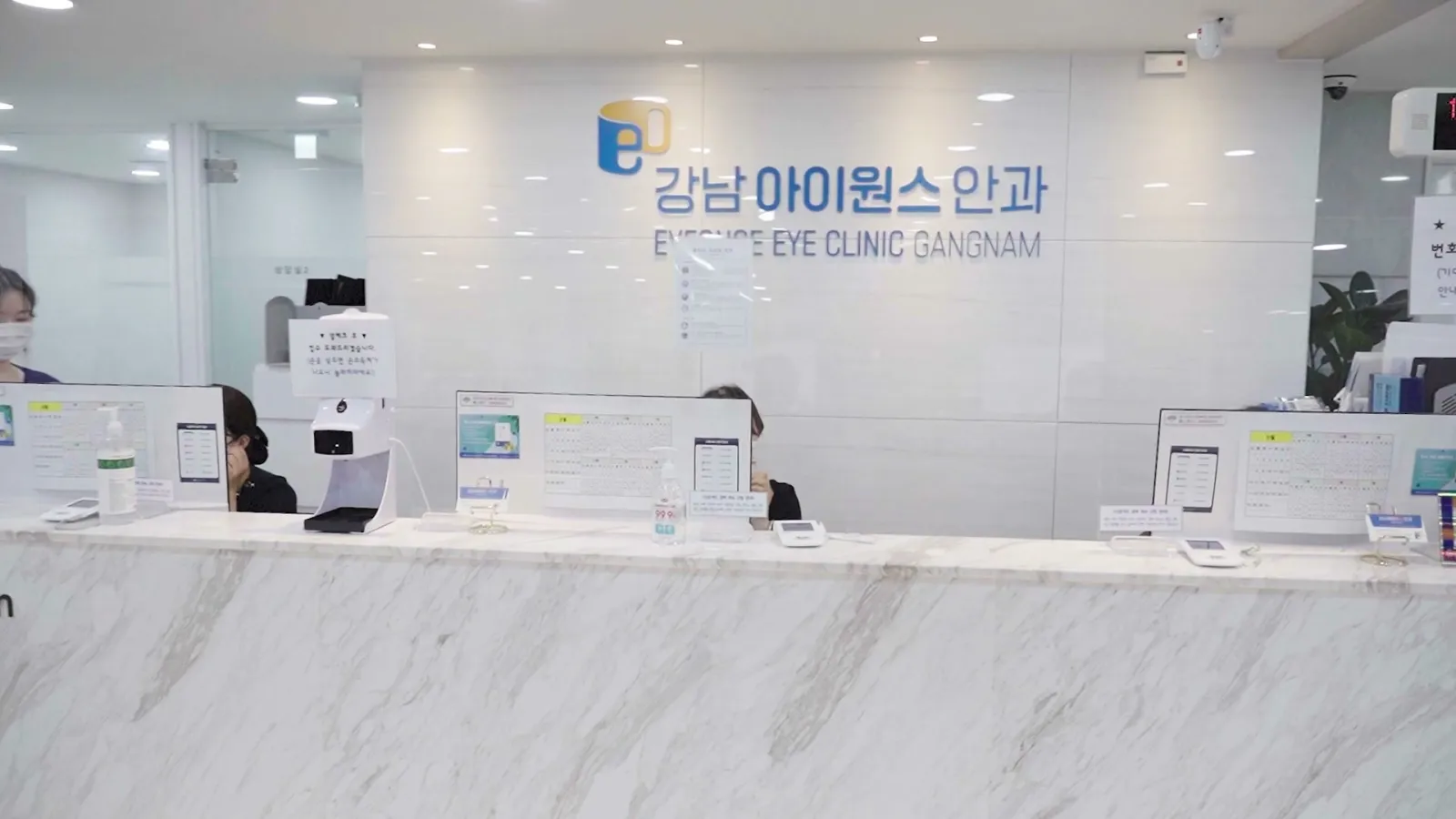
For what the first days after a flapless procedure look like, see SMILE LASIK recovery and daily life, and the overview of eye surgery in South Korea covers the trip as a whole.
Before you plan a trip, photograph your glasses prescription with the SPH, CYL and AXIS columns visible, add any corneal map printout you have, and send them on WhatsApp with the dates you're considering. When you come to Seoul, I examine your eyes and recommend the method that fits them.
Results and suitability vary by individual. Your procedure recommendation is confirmed only through an in-person diagnostic exam.

Representative Director · Former Clinical Instructor, Dept. of Ophthalmology, Samsung Seoul Hospital · Member, Korean Society of Cataract and Refractive Surgery · Member, American Society of Cataract and Refractive Surgery
International patients share what actually happened — from their first fears to waking up the next morning without glasses.
Our patients share their stories on Google — verified, public and unfiltered. Open the map to read every review straight from the source.
Tell us your prescription and travel dates. Our English-speaking team will design your personalized plan — free of charge, no pressure.
An English-speaking eye clinic in the heart of Gangnam, Seoul — moments from Sinnonhyeon Station and easily reached from Incheon International Airport.
5–6F, Duo Sinnonhyeon, 368 Sapyeong-daero, Seocho-gu, Seoul, South Korea
+82-10-6308-0984 — English, Chinese, Mongolian & Thai
Mon, Tue, Thu, Fri 09:00–18:00 · Sat 09:00–16:00 · Lunch break 13:00–14:00 · Closed Wed & Sun
By appointment only · Registration may close early depending on the day’s schedule.
Sinnonhyeon Station (Line 9 / Sinbundang Line) — 3 min walk. Gangnam Station (Line 2) nearby.